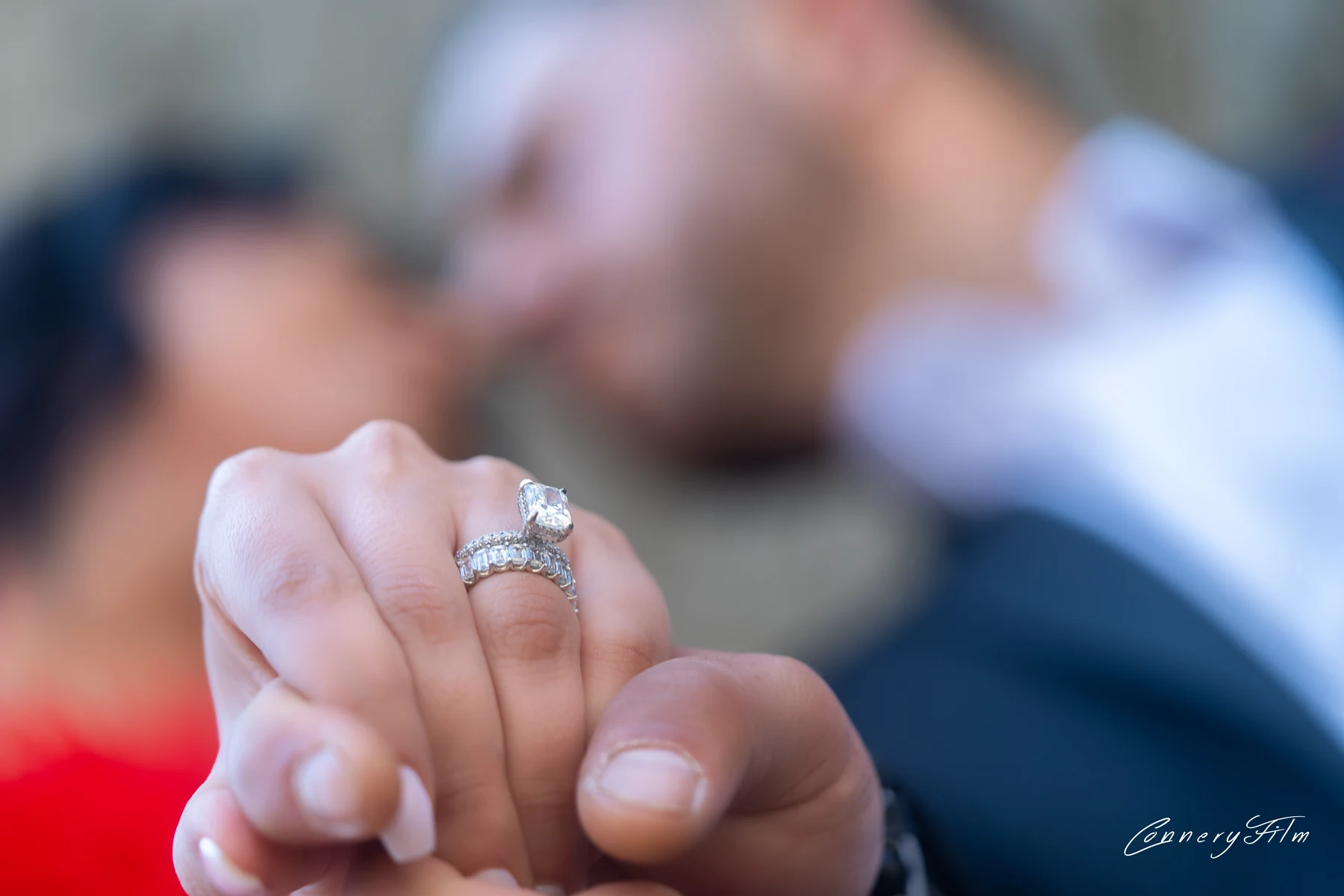
Here's the blunt answer to how you choose photos for your wedding album: you don't start with your favorites. You start with the story of the day, in order, and you cut until what's left is something a person could flip through in ten minutes without getting tired. For most Los Angeles couples I work with, that lands at 60 to 80 images across 25 to 30 spreads, pulled from a gallery of 500 to 700 edited photos.
I've sat across a laptop from a lot of couples doing this. Almost everyone makes the same mistake in the first twenty minutes, and it's worth knowing before you open your gallery.
Start with the timeline, not the favorites
Couples open the gallery, scroll, and heart every photo that makes them gasp. By the end they have 240 hearts, and 90 of them are the same portrait at slightly different angles. That isn't an album. That's a highlight reel with no spine.
Do this instead. Before you pick a single image, write six or seven chapter headings on paper: getting ready, first look or ceremony, family, couple portraits, cocktail hour, reception, dancing. Then give each chapter a spread budget. A typical 30-spread album might look like this:
- Getting ready and details: 3 to 4 spreads
- First look and ceremony: 5 to 6 spreads
- Family and wedding party: 3 spreads
- Couple portraits: 6 to 7 spreads (this is the heart of the album)
- Cocktail hour and reception: 5 to 6 spreads
- Dancing and the exit: 3 to 4 spreads
Now you're choosing the best frames for a slot instead of hunting for a hundred best frames in a vacuum. It's so much easier. If you want the full printing-side logic, I wrote up a 3-pass method for choosing wedding photos to print, and the same passes work for an album.
My three-pass cull for an album
Pass one is fast and ruthless. Go through the whole gallery and mark anything that makes you feel something. Don't think. Don't compare. You'll end up with 150 to 250 images, and that's fine for now.
Pass two is where the discipline lives. Group your picks by chapter and look for duplicates. Where you have five frames of the same moment, keep the one where both of your faces are doing something real. I'll take a slightly soft frame with a genuine laugh over a technically perfect one where someone is mid-blink, every time. Most photographers won't tell you that, because we're proud of sharp focus. But nobody has ever cried over a crisp photo of an empty smile.
Pass three is the reading test. Put the survivors in order and scroll through them like pages. Where does your eye get bored? Where do you want one more frame, a wide shot to show the room, or a close-up to reset the pace? Fill those gaps with a detail photo, a ring, a boutonniere, a hand on a shoulder. Albums need rests, the way a song needs rests.
Mix wide, medium and tight
This is the thing amateurs skip and designers love. A spread of six medium portraits looks flat. A spread with one full-bleed wide shot of you two under the arch at a Malibu bluff, a tight shot of hands, and a medium frame of the kiss feels like a film sequence.
When I'm shooting, I'm deliberately giving you all three on every important moment: a wide to set the place, a medium for the people, and a tight for the feeling. When you choose album photos, try to keep that rhythm. One big hero image per spread, supported by one or two smaller ones.
Put your strongest verticals and horizontals where the layout wants them. Panoramic horizontals can run across the center fold of a spread, but a face sitting on the gutter is a crime. Your designer will catch that, but it helps to know why a few of your favorites get passed over.
Let light make some of the decisions
Los Angeles light is a character in your album, so pay attention to it. Late afternoon at a venue like a hillside estate in Malibu or a rooftop downtown gives you warm, directional light for about 25 minutes before it flattens out. Those frames will tend to be your hero images. Harsh midday sun at an outdoor ceremony, on the other hand, is something I fight constantly, and the frames that survive are usually the ones where I found shade or backlit you. If your album has a color story, it's usually decided by which portraits came from that good-light window.
One practical tip: if you're torn between two near-identical portraits, pick the one with the better light on the face, not the better pose. Light is hard to fix. Poses are not what people remember.
What I'd do if it were my wedding
I'd go in with a cap, 30 spreads, and I would not break it. I'd choose the ceremony photos by who's in them, not by how pretty they are: the parent reacting, the friend wiping a tear, the officiant mid-joke. Those frames get more valuable every year. I'd limit the group shots to the three or four that actually matter, and I'd skip the posed shot of the cake entirely and keep the one where somebody is stealing frosting.
And I'd have one person, not five, with final say. Albums made by committee are tired. If you and your partner disagree about a photo, the person who loves it more gets it. Trade for the next one. Done.
How many photos fit, and what it costs
A 30-spread album holds roughly 60 to 80 photos if you vary the layouts, and more if you do collages. A 40-spread album can hold 100 or so, but I think it starts to drag. For how I think about length, I have a post on keeping a wedding album to about 30 spreads. On cost, albums in Los Angeles typically run $600 to $2,500 depending on size, cover material and paper, and I break down the cost and whether it's worth it separately. If you're weighing a lighter-weight option, there's also a comparison of photo books and albums.
Where your photographer fits in
You don't have to do this alone, and honestly you shouldn't. Because I shoot and edit your gallery, I already know which frames carry the day. At ConneryFilm we handle both photography and cinematic film under one roof, so when you're picking album images I can also tell you which moments are already covered in your wedding film and which only exist as stills. That prevents you from using a spread on something that's better remembered in motion. My studio's photography starts at $1,599, and photo and film together start at $3,500, and album design guidance is part of how I work with couples whether we're talking about how I cull 4,000 shots down to 600 edited ones or building the final layout.
FAQ
How many photos should go in a wedding album?
Plan on 60 to 80 photos for a 30-spread album. Go lower if you want more full-page images, higher if you like collage-style spreads. Past about 100 photos, most albums start to feel like a slideshow.
Should I put every photo from the gallery in the album?
No. A gallery of 500 to 700 edited photos is meant to be browsed. An album is meant to be edited tightly, and the cut is what makes it feel like a story.
Who should choose the photos, me or my photographer?
Both, in order. You pick what matters emotionally, and your photographer helps with flow, pacing and layout. I usually suggest a first-draft selection from you, then a design pass where we fix gaps and weak spots together.
How long does album design take?
Plan on your selection taking a week or two, the design draft another 2 to 3 weeks, and printing and shipping 4 to 8 weeks after you approve it. Start while the wedding is still fresh.
Is it okay to include black and white photos?
Yes, in moderation. A few black and white spreads for emotional moments like vows and parent portraits look timeless, but if more than a fifth of the album is monochrome, it tends to feel inconsistent.
If you're sitting on a gallery you don't know how to cut, or planning a Los Angeles wedding and want a team that thinks about the album before the first shutter click, I'd love to hear from you. Call or text 818.749.7039 or visit ConneryFilm.com and let's talk about your day.
Meet the Author: Connery Davoodian Hello, I'm Connery Davoodian, the visionary behind ConneryFilm, and I'm thrilled to share insights from my 17-year journey through the world of wedding photography and videography. My passion extends beyond simply capturing images; it's about artfully weaving your unique love story into a timeless, cinematic masterpiece. My artistic path began long before I ever picked up a camera, deeply rooted in music as a singer, songwriter, and multi-instrumentalist. This diverse background in directing, producing, and editing has cultivated a unique perspective, allowing me to approach each wedding not just as an event, but as a dynamic narrative waiting to be beautifully told. This blend of technical mastery and creative storytelling is the heartbeat of ConneryFilm, ensuring that every frame, every shot, and every film is infused with depth, emotion, and unparalleled artistic integrity. At ConneryFilm, we believe your wedding memories deserve nothing less than bespoke luxury. My philosophy centers on capturing the authentic, unscripted moments – the genuine smiles, the tender glances, the joyful laughter – that truly define your day. While we obsess over exquisite details and sophisticated aesthetics, our true joy comes from making you feel completely at ease, like a "friendor" who genuinely celebrates alongside you. This calm, organized presence allows your true personalities to shine, resulting in images and films that are as real and vibrant as your love itself. Based in the heart of Los Angeles, California, my team and I are privileged to serve couples across the globe, bringing our signature high-end wedding photography and videography to destination weddings worldwide. Through these blog posts, I aim to share invaluable insights, luxurious inspiration, and practical, fun advice to guide you through your wedding planning journey, helping you make informed decisions about preserving your most cherished moments. Thank you for trusting ConneryFilm to be a part of your extraordinary adventure. I'm excited to share my knowledge and passion with you, helping you create memories that will last forever.