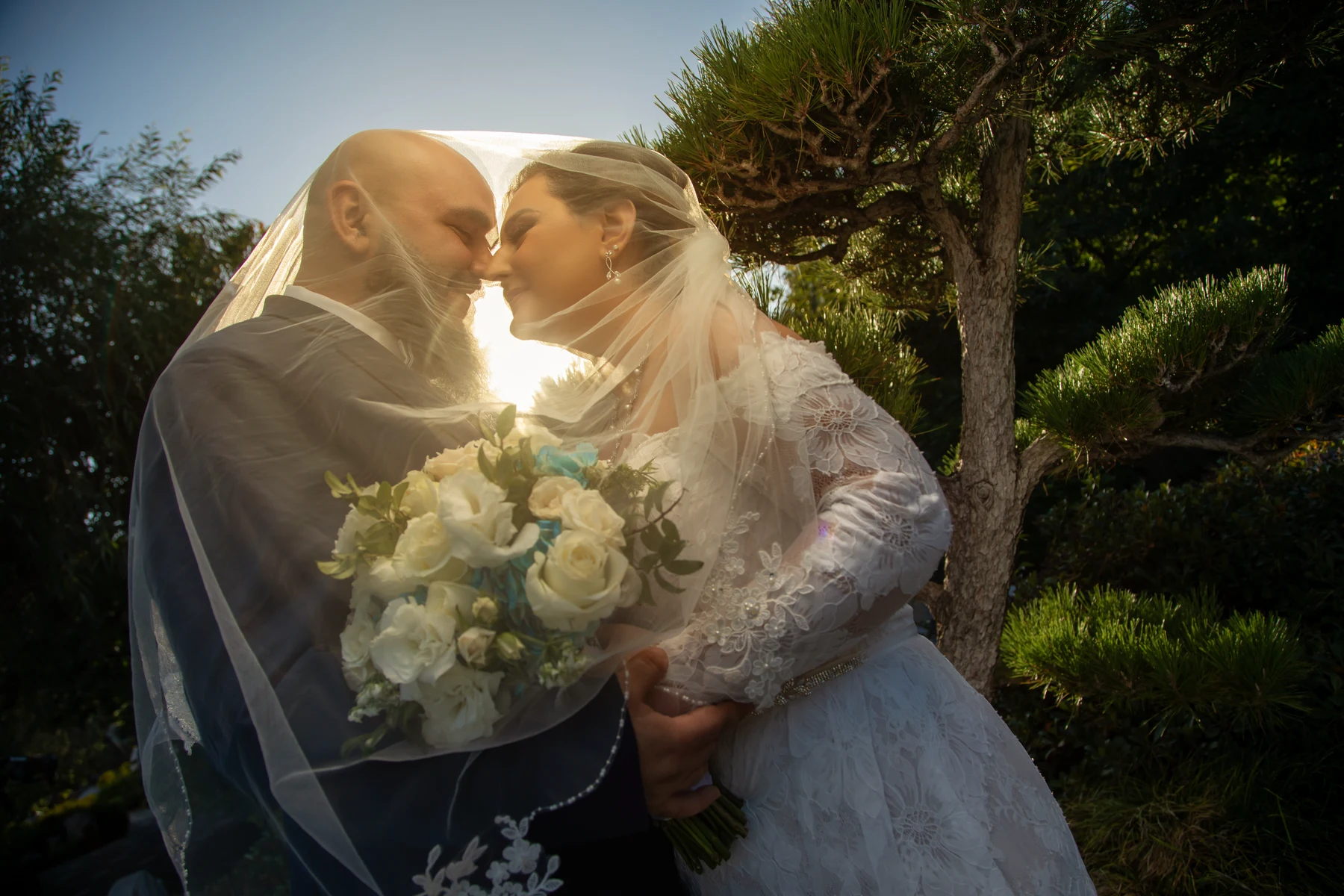
Editorial vs documentary wedding photography is one of the first questions couples ask me at consultations in Los Angeles, usually right after they've scrolled through fifty Instagram accounts and noticed that half look like magazine spreads and the other half look like a candid family album. Here's my blunt answer after 17 years: you don't pick one. You pick the ratio. For most weddings I shoot, that ratio lands around 70% documentary and 30% editorial, and the couples who get that balance right are the ones who still love their gallery ten years later.
Let me break down what each style actually is, what it costs you in time on the day, and how to figure out your own mix.
What "editorial" really means (it's not just pretty light)
Editorial wedding photography borrows from fashion and magazine work. I'm directing. I choose the spot, I place you in the light, I tell you where to put your hands, and I'm thinking about composition the way a Vogue shooter would: negative space, strong lines, the dress as a shape, the architecture as a frame. The images feel intentional and polished.
In practice, editorial work happens in specific windows of the day:
- Bridal and groom portraits after getting ready, usually 15-25 minutes each.
- Couple portraits, ideally split between a 20-minute block after the ceremony and a 15-20 minute golden hour session.
- Detail flat lays of rings, invitations, shoes and florals, about 30 minutes while you're in hair and makeup.
- Wedding party portraits that are styled rather than lined up like a school photo.
The trade-off is time and energy. Editorial images need you present in front of the camera, and they need me controlling the scene. A great editorial portrait at the Millennium Biltmore's Crystal Ballroom or on the steps of a Pasadena estate might take eight minutes for three frames I'd put in a portfolio.
What "documentary" really means (it's not just "unposed")
Documentary wedding photography is me disappearing. I'm watching, anticipating and reacting. Your dad reading the letter you wrote him. Your flower girl asleep under the sweetheart table at 9:40 PM. Your best friend crying during her toast before she even starts talking. I don't stop anything or ask anyone to redo it. If I miss it, it's gone.
Most photographers won't say this, but documentary work is harder than editorial. Editorial rewards good taste and good direction. Documentary rewards reading a room: knowing that the groom's grandmother is about to reach for his hand, or that the DJ is about to call the bouquet toss, so I'm already standing on the right side of the dance floor. That skill takes years of weddings, not years of Lightroom.
It overlaps a lot with what I've written about candid vs. posed wedding photos, but documentary goes a step further. Candid can still mean "I nudged you into a nice spot and waited." True documentary means I never touched the scene.
Side by side: the differences that actually affect your day
- Your time in front of the camera: editorial-heavy days need 90-120 minutes of portraits and styled coverage; documentary-heavy days need 30-45 minutes.
- Timeline pressure: editorial needs protected blocks in the schedule; documentary works around whatever the day throws at it.
- Light dependency: editorial lives and dies by light quality; documentary accepts whatever light exists and works with it, including dim reception halls.
- How you'll feel: editorial can feel like a photoshoot (fun for some couples, exhausting for others); documentary feels like I'm a guest with a camera.
- What the gallery looks like: editorial produces 40-80 hero images you'll print large; documentary produces the 300-500 frames that tell the story in order.
- Editing: editorial images get more retouching per frame; documentary images get consistent color and toning across hundreds of frames.
Neither style costs more by itself in LA. Where price moves is coverage hours. If you want both a full editorial portrait session and complete documentary coverage of a 150-guest reception, you're typically looking at 8-10 hours, which in Los Angeles usually means somewhere in the $3,500-$6,500 range for an experienced photographer.
Why I think a pure editorial wedding is a mistake
I'll be blunt: I've seen couples book photographers whose portfolios are 100% editorial, and a year later they're disappointed. Not because the portraits were bad. The portraits were stunning. But the gallery had 60 gorgeous images of two people and almost nothing of their grandparents, their college roommates, or the moment their nephew stole the microphone.
Those portfolio pages you love were curated from styled shoots or from the best 2% of real weddings. What you don't see is whether that photographer can work a crowded ballroom in Downtown LA at 8 PM with mixed tungsten and LED uplighting. Always ask to see a full wedding gallery before you book. That's where you'll learn whether their documentary skills match their editorial highlight reel.
And the opposite problem exists too. A purely documentary wedding with zero direction often leaves couples without a single portrait they'd frame above the fireplace. You spent a year choosing that dress and that venue. You deserve a handful of images that look like art.
How LA light shapes the editorial part of your day
This is where local experience matters. Editorial portraits need controlled light, and Los Angeles light is beautiful and brutal depending on the hour.
- Malibu and Palos Verdes beaches: midday sun from 11 AM to 3 PM is harsh and flat, with raccoon-eye shadows. I schedule editorial portraits for the last 45 minutes before sunset, and I warn couples that golden hour on the coast in summer can disappear into marine layer fog without notice.
- Downtown rooftops: buildings cast shadows early. On a DTLA rooftop the direct sun is often gone 30-40 minutes before official sunset, so I move the portrait block earlier than couples expect.
- Estates in Calabasas, Agoura Hills and Ojai: open oak shade gives soft light for editorial work almost any time after 3:30 PM, which is a gift.
- Indoor venues: editorial portraits indoors mean I'm bringing off-camera flash or finding a big window. A hotel ballroom with no windows gets zero natural editorial light, period.
Golden hour in LA is shorter than people think. I've written about how LA golden hour lasts about 25 minutes, and that's exactly why editorial moments need to be scheduled, not hoped for.
How to find your own ratio: three questions I ask every couple
At consultations, I don't ask "which style do you like?" because everyone says both. Instead I ask these:
1. Which photo on your wall right now would you save in a fire? If it's a candid snapshot of your grandmother laughing, you're documentary-leaning. If it's a stylish portrait from your engagement session, you lean editorial.
2. How do you feel about 90 minutes of portraits? Some couples light up. Some couples visibly wilt. If you'd rather be at cocktail hour with your friends, protect that time and go 80/20 documentary.
3. How many people are coming, and how many of them flew in? A 40-person intimate dinner in Topanga can run heavier on editorial because there's less to document. A 250-guest wedding with family flying in from three countries needs me watching the room, not styling you on a staircase for an hour.
My rough guide:
- Micro wedding under 50 guests: 50/50 works beautifully.
- Standard 100-180 guest wedding: 70/30 documentary to editorial.
- Large cultural wedding, 200+ guests, multiple ceremonies: 80/20, with a second shooter covering documentary while I handle portraits.
What I'd do if it were my wedding
Honestly, I'd do a first look. It's the single best way to get both styles without sacrificing either. The first look itself gets shot documentary style: I hide behind a column and capture the reaction as it happens. Then we flow straight into 25 minutes of editorial portraits while everyone's fresh and the makeup is perfect. That frees the post-ceremony window for family formals and gets you to cocktail hour.
Then I'd protect one 15-minute golden hour slot, stepping out during dinner service or right after the first dance. Everything else? Pure documentary. Let the day happen.
If you want a starting point for building that into the schedule, my realistic LA wedding day timeline shows where each block usually fits.
Where video fits into the editorial vs documentary question
This is one reason I built ConneryFilm as photography and cinematic film under one roof. The same tension exists in video: cinematic, directed shots of the couple versus raw documentary coverage of toasts and vows. When photo and video are two separate vendors, they fight for the same 20-minute portrait window, and your editorial time gets cut in half while two crews argue about angles.
When it's one team, we plan the editorial portraits together. My photographer and filmmaker move in sync, one captures stills while the other gets motion from a complementary angle, and you spend 20 minutes on portraits instead of 40. During documentary coverage, we split the room so nothing gets missed. It's calmer for you, and the photos and film feel like they came from the same wedding, because they did.
FAQ: editorial vs documentary wedding photography
Is editorial wedding photography more expensive in Los Angeles?
Not inherently. Price is driven by hours of coverage, the number of shooters and deliverables. An editorial-heavy day may need an extra hour for portraits, which typically adds $300-$600 with experienced LA photographers.
Can one photographer do both editorial and documentary well?
Yes, and most experienced wedding photographers do. The test is a full gallery: look for strong portraits and strong candid reception coverage in the same wedding, not just a highlight reel from different events.
Is documentary wedding photography the same as photojournalism?
Essentially yes. Wedding photojournalism and documentary wedding photography both mean capturing real moments without directing them. Some photographers use "documentary" to sound more artistic, but the approach is the same.
How many editorial portraits should I expect in my gallery?
For an 8-hour wedding with 60-75 minutes of portrait time, expect roughly 60-120 edited editorial-style images out of a 500-700 image gallery.
Does editorial style work for shy couples?
It can, if the photographer directs with movement rather than stiff poses. Walking, whispering, and slow dancing prompts give editorial compositions without that frozen, on-display feeling.
If you're trying to figure out the right mix of editorial and documentary for your own wedding, I'd love to talk it through with you, look at your venue and your timeline, and show you full galleries from weddings like yours. Call or text 818.749.7039, or take a look at our work and packages at ConneryFilm.com. Photos and film, one team, and a day that actually feels like yours.
Meet the Author: Connery Davoodian Hello, I'm Connery Davoodian, the visionary behind ConneryFilm, and I'm thrilled to share insights from my 17-year journey through the world of wedding photography and videography. My passion extends beyond simply capturing images; it's about artfully weaving your unique love story into a timeless, cinematic masterpiece. My artistic path began long before I ever picked up a camera, deeply rooted in music as a singer, songwriter, and multi-instrumentalist. This diverse background in directing, producing, and editing has cultivated a unique perspective, allowing me to approach each wedding not just as an event, but as a dynamic narrative waiting to be beautifully told. This blend of technical mastery and creative storytelling is the heartbeat of ConneryFilm, ensuring that every frame, every shot, and every film is infused with depth, emotion, and unparalleled artistic integrity. At ConneryFilm, we believe your wedding memories deserve nothing less than bespoke luxury. My philosophy centers on capturing the authentic, unscripted moments – the genuine smiles, the tender glances, the joyful laughter – that truly define your day. While we obsess over exquisite details and sophisticated aesthetics, our true joy comes from making you feel completely at ease, like a "friendor" who genuinely celebrates alongside you. This calm, organized presence allows your true personalities to shine, resulting in images and films that are as real and vibrant as your love itself. Based in the heart of Los Angeles, California, my team and I are privileged to serve couples across the globe, bringing our signature high-end wedding photography and videography to destination weddings worldwide. Through these blog posts, I aim to share invaluable insights, luxurious inspiration, and practical, fun advice to guide you through your wedding planning journey, helping you make informed decisions about preserving your most cherished moments. Thank you for trusting ConneryFilm to be a part of your extraordinary adventure. I'm excited to share my knowledge and passion with you, helping you create memories that will last forever.