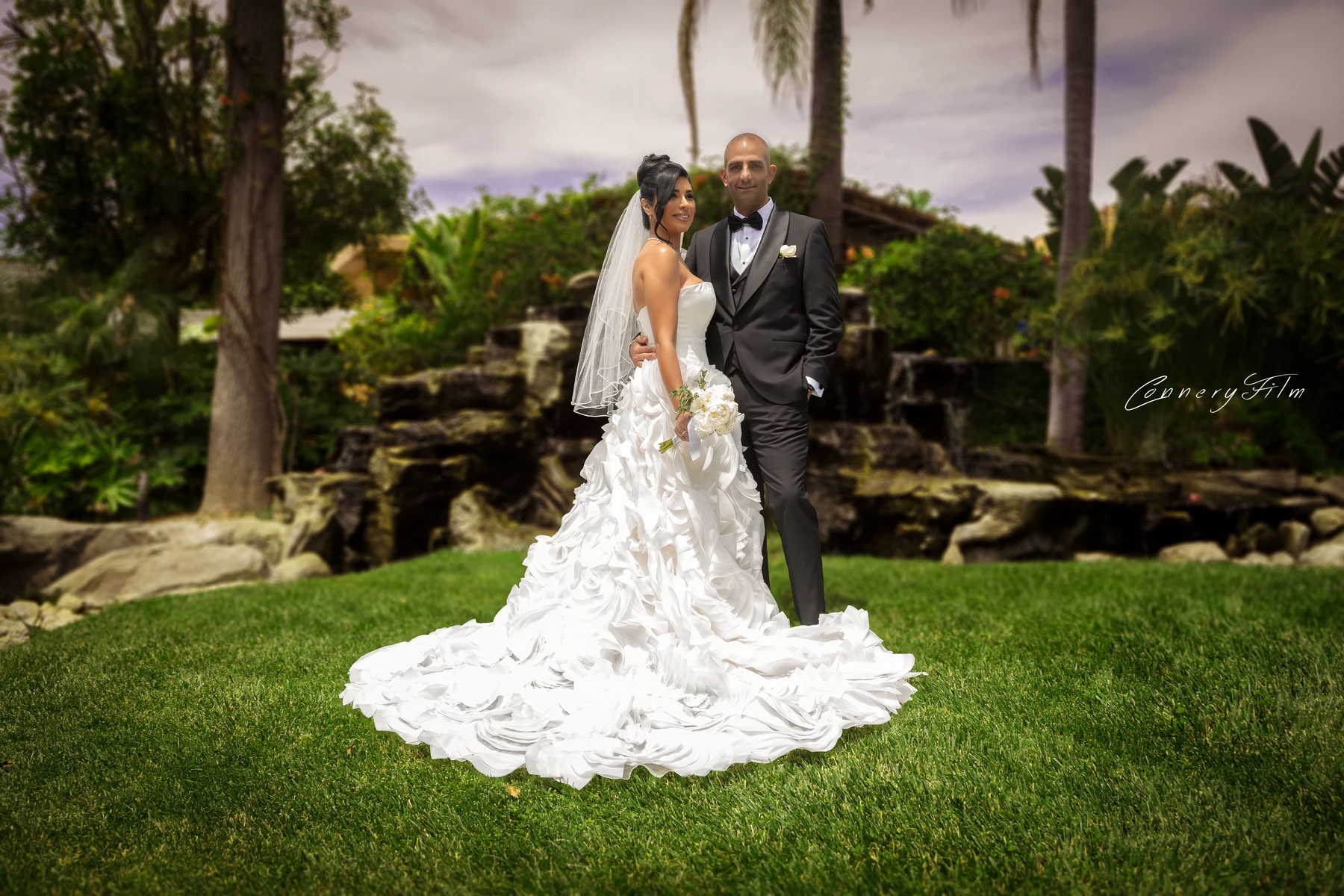
Here is the short answer I give every couple who asks how to plan a wedding timeline around golden hour photos in Los Angeles: look up your exact sunset time, then build the whole day backward from it. Your ceremony should end roughly 90 minutes before sunset, and the two of you should be free for portraits for the final 30 to 45 minutes before the sun touches the horizon. Everything else, from hair and makeup to the grand entrance, gets placed around that window, not the other way around.
I have photographed and filmed weddings for 17 years, and I can tell you the single most common reason couples end up without the glowing, warm portraits they saved on Pinterest is not the photographer, the camera, or the weather. It is a timeline that was written by someone who never checked when the sun goes down.
Step one: get your real sunset time, not a guess
Los Angeles sunset swings by more than three hours across the year, and daylight saving time makes it jump overnight. Rough numbers I plan around:
- Late June: sunset around 8:05 to 8:10 PM
- Early September: around 7:15 PM
- Mid October: around 6:25 PM
- Mid November (after the clocks fall back): around 4:50 PM
- Mid December: around 4:45 PM, the earliest of the year
- Mid March (after the clocks spring forward): around 7:05 PM
Pull the exact minute for your date from any sunset calculator, and write it at the top of your timeline in bold. I mean that literally. When I send couples a draft timeline, the sunset time is the first line on the page, because every vendor should see it.
One more wrinkle that is very LA: the sunset on your app is when the sun hits a flat horizon. If your venue sits in a canyon in Malibu, below the hills in Topanga, or on the east side of a ridge in the Santa Monica Mountains, the sun will disappear behind terrain 20 to 40 minutes earlier than the app says. At a beach venue in Palos Verdes or Point Dume, you get the full sunset over the ocean. At a downtown rooftop, nearby towers can block the last half hour. When I scout, I check where the sun will actually drop, and you should ask your photographer to do the same.
What "golden hour" really means for your photos
Golden hour is the stretch before sunset when the sun is low, soft, and warm. In Southern California it rarely lasts a full hour of truly beautiful light. In my experience, the best 25 minutes are usually the ones right before the sun goes down, which is why I wrote about how LA golden hour lasts about 25 minutes and why that should shape who you hire.
After sunset you also get 15 to 20 minutes of blue hour, when the sky turns pink and lavender and the light wraps around everyone evenly. Some of my favorite frames from Santa Monica and Laguna weddings came from those minutes, with the string lights of the reception just turning on behind the couple.
I will be blunt: high noon in Los Angeles is harsh. Midday light in July at an open estate in Calabasas or a vineyard in Temecula puts hard shadows under eyes and makes everyone squint. A timeline that schedules all of your portraits at 1 PM and none near sunset is leaving the best light of the day on the table.
A sample timeline built backward from a 6:25 PM October sunset
Let's use a real-feeling example: an October Saturday, sunset at 6:25 PM, ceremony and reception at the same venue in the Santa Monica Mountains, couple doing a first look.
- 12:00 PM Photographer and filmmaker arrive, details and getting ready
- 1:30 PM Dress and suit on, final touches
- 2:00 PM First look
- 2:15 PM Couple portraits and wedding party (in shade, because the light is still hard)
- 3:15 PM Immediate family formals
- 3:45 PM Tuck the couple away, guests arrive
- 4:30 PM Ceremony begins
- 5:00 PM Ceremony ends, which is about 85 minutes before sunset
- 5:00 to 5:30 PM Remaining extended family photos, then cocktail hour for guests
- 5:40 to 6:20 PM Golden hour portraits, just the two of you
- 6:20 to 6:40 PM Sunset and blue hour frames, then grand entrance
- 6:45 PM Dinner, toasts and dancing
Notice what is happening. Because the big group photos were done earlier, the golden hour slot is only for you. No aunt is waiting to be pulled into a frame, no coordinator is tapping a watch. That is how you get the relaxed, intimate portraits, not the rushed version.
Why I push couples toward a first look
Most photographers won't say this so directly, but honestly, I think a first look is the single biggest favor you can do for your golden hour photos. It moves the wedding party and family formals into the afternoon, and it means the cocktail hour is not swallowed by a 45-person group shot list. I have a whole post on taking wedding photos before the ceremony if you are on the fence.
If you want the traditional moment at the aisle instead, that is completely fine, and I have shot plenty of beautiful weddings that way. You just need a later ceremony, or a longer cocktail hour, to make room for 60 to 90 minutes of post-ceremony photos. In that case, the formula shifts: end the ceremony 2 hours before sunset, run family formals first, wedding party second, and then the two of you slip out for the last 30 minutes of warm light.
Where couples get the timing wrong
A few patterns I see over and over at consultations:
- Ceremony right at sunset. It sounds romantic. In practice you are standing under the arch while the best light happens behind your guests, and by the time you walk back down the aisle the sky is gray. I would rather you get married in good light and then have portraits in great light.
- Dinner scheduled during golden hour. In summer, with an 8 PM sunset, a 6:30 PM dinner looks normal on paper. Then the sun drops while you are cutting into a steak. Ask your caterer to move the first course, or plan a 20-minute break between courses for a sunset walk.
- Forgetting the drive. If your portraits happen at a different spot, like the bluffs above El Matador Beach or a rooftop in the Arts District, budget real LA traffic. On a Saturday afternoon, 6 miles on PCH can take 35 minutes.
- Winter weddings planned like summer ones. A December wedding with a 4:45 PM sunset needs a ceremony around 2:30 or 3 PM. I have seen invitations printed for a 5 PM December ceremony with outdoor portraits planned afterward. There was nothing left to photograph but darkness and flash.
How the light changes by venue type around LA
Beach weddings in Malibu, Santa Monica or Laguna get the most direct golden light, and also the most wind. The sun sits low over the water, so I often shoot with it behind you for a backlit glow, then turn you toward it for the final few minutes when it is soft enough to face.
Canyon and mountain estates like those in Topanga, Agoura Hills or Malibu Canyon lose direct sun early. Plan your golden hour portraits 30 minutes earlier than the official sunset and look for an open spot on high ground.
Downtown and Hollywood rooftops get gorgeous city glow after sunset. Here, blue hour is often more valuable than golden hour. Budget 15 minutes right after sunset for skyline frames before the grand entrance.
Vineyards and ranches in Malibu wine country or Temecula have open western exposure, so the full hour before sunset is usually usable. These are some of the easiest venues to time well.
Why one photo and film team makes this easier
Golden hour is short, and you do not want two separate vendors negotiating over 25 minutes of light. At ConneryFilm, photography and cinematic film happen under one roof, so my photo and film team plan the same timeline, scout the same light, and move as one unit during portraits. The filmmaker knows exactly where I will place you, and you are not asked to repeat the same walk three times for two different crews. For couples, that usually means more portraits in less time and less standing around while the sun disappears.
If you want to see how the whole day fits together beyond sunset, my post on a realistic LA wedding day photography timeline walks through the rest of the hours.
What I would do if it were my wedding
I would pick a date between late September and early November, when LA light is warm, the heat has broken and sunset falls between 6 and 7 PM. I would do a first look, end the ceremony about 90 minutes before sunset, and protect a 40-minute block at the end of cocktail hour for just the two of us. I would tell the coordinator that block is not negotiable. And I would keep the shot list for that window to almost nothing, because the best golden hour images come from walking, laughing and being left alone with the light.
Golden hour timeline FAQ
How long should golden hour portraits take at a wedding?
Plan 20 to 40 minutes for couple portraits in golden hour, plus 10 to 15 minutes after sunset for blue hour frames. More than that usually pulls you away from your guests for too long.
What time should an LA ceremony start for golden hour photos?
For a 30-minute ceremony, start it about 2 hours before sunset. With a 6:25 PM October sunset, that means a 4:30 PM start. In June, with an 8:05 PM sunset, a 6 PM start works well.
Can we still get golden hour photos without a first look?
Yes. End the ceremony about 2 hours before sunset, do family and wedding party photos right after, and save the final 30 minutes before sunset for the two of you during cocktail hour.
What if it is cloudy or the marine layer rolls in?
June gloom and coastal fog are real in Santa Monica and Malibu. Overcast light is soft and very flattering, so the portraits still look beautiful, just cooler in tone. Keep the slot in the timeline anyway; clouds often break right at sunset.
Should we leave the reception for sunset photos in summer?
If your sunset is after 7:30 PM, yes. A 15 to 20 minute sunset walk between dinner courses or right after toasts is one of the best trades you can make on a summer wedding day.
If you are planning your timeline now and want someone to look at it with the sun in mind, I would love to help. Send me your date and venue, and I will tell you exactly where your golden hour falls and how I would build the day around it. Call or text 818.749.7039, or say hello at ConneryFilm.com. I can't wait to hear about your wedding.
Meet the Author: Connery Davoodian Hello, I'm Connery Davoodian, the visionary behind ConneryFilm, and I'm thrilled to share insights from my 17-year journey through the world of wedding photography and videography. My passion extends beyond simply capturing images; it's about artfully weaving your unique love story into a timeless, cinematic masterpiece. My artistic path began long before I ever picked up a camera, deeply rooted in music as a singer, songwriter, and multi-instrumentalist. This diverse background in directing, producing, and editing has cultivated a unique perspective, allowing me to approach each wedding not just as an event, but as a dynamic narrative waiting to be beautifully told. This blend of technical mastery and creative storytelling is the heartbeat of ConneryFilm, ensuring that every frame, every shot, and every film is infused with depth, emotion, and unparalleled artistic integrity. At ConneryFilm, we believe your wedding memories deserve nothing less than bespoke luxury. My philosophy centers on capturing the authentic, unscripted moments – the genuine smiles, the tender glances, the joyful laughter – that truly define your day. While we obsess over exquisite details and sophisticated aesthetics, our true joy comes from making you feel completely at ease, like a "friendor" who genuinely celebrates alongside you. This calm, organized presence allows your true personalities to shine, resulting in images and films that are as real and vibrant as your love itself. Based in the heart of Los Angeles, California, my team and I are privileged to serve couples across the globe, bringing our signature high-end wedding photography and videography to destination weddings worldwide. Through these blog posts, I aim to share invaluable insights, luxurious inspiration, and practical, fun advice to guide you through your wedding planning journey, helping you make informed decisions about preserving your most cherished moments. Thank you for trusting ConneryFilm to be a part of your extraordinary adventure. I'm excited to share my knowledge and passion with you, helping you create memories that will last forever.