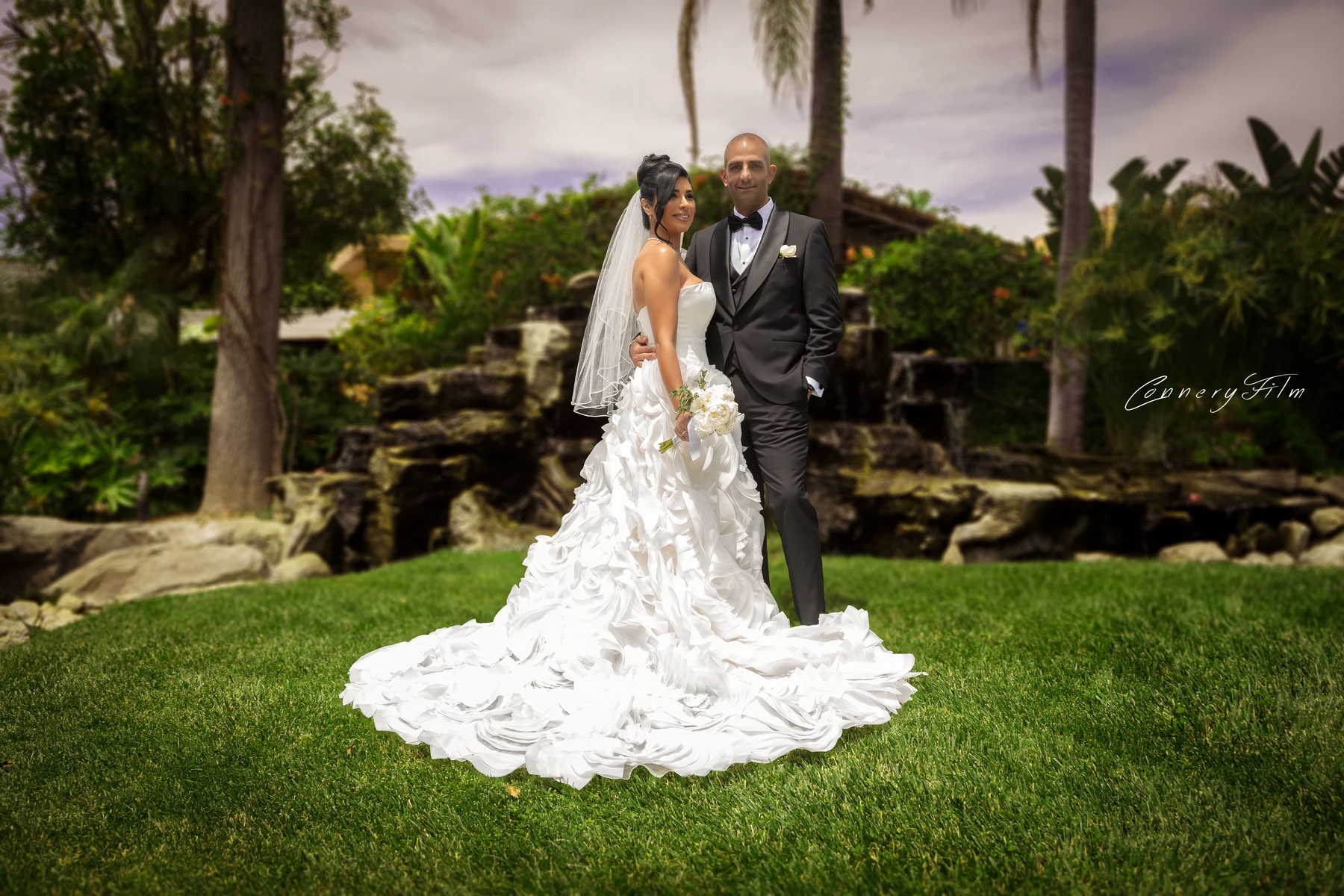
Here's my short answer. The biggest benefit of a husband-and-wife or two-person photo-video team in Los Angeles isn't romance, and it isn't a discount. It's that the photographer and the filmmaker stop competing for the same six square feet in front of you. When two people have worked side by side for years, they move like one crew: one steps left so the other gets the shot, nobody blocks the aisle, and your day runs on one timeline instead of two.
I've filmed and photographed weddings in LA for 17 years, and I've worked both ways: alongside a separately hired vendor I met in the parking lot that morning, and inside a team that has rehearsed every moment of a wedding day together dozens of times. The difference shows up in the final photos and the final film. Let me walk you through where it actually matters, and where it doesn't.
Honestly, the "married" part matters less than you think
I'll be blunt: a husband-and-wife label on a website tells you nothing about the work. What you're really paying for is repetition. Two people who have shot 100+ weddings together know each other's habits without a word. Sometimes that's a married couple. Sometimes it's siblings, or a lead shooter and a filmmaker who have worked together for a decade. The relationship is a nice story. The shared muscle memory is the product.
So when couples ask me whether they should specifically look for a married team, I tell them to ask a different question: "How many weddings have the two of you shot together, and can I see a full gallery and a full film from the same day?" If the photos and the film from one wedding look like they belong to the same story, you've found a real team.
Win #1: Nobody walks into anybody's shot
This is the one couples never think about until they see it go wrong. At a ceremony, there are maybe three or four good spots to stand. The photographer wants the center aisle for the processional. The videographer wants it too, because that's where the gimbal shot of the walk looks best. When those two people are strangers, one of them ends up in the background of the other's best frame. I've watched a separately booked videographer plant a tripod dead center at a Malibu bluff ceremony, and the photographer spent the entire vows shooting around a black stand that showed up in half the wide shots.
A two-person team plans this before the day. Typically it looks like this:
- Processional: photographer at the end of the aisle, low and centered; filmmaker on the side with a long lens, so neither appears in the other's frame.
- Vows: one person behind the officiant's shoulder for the faces, the other on the opposite side catching reactions, with a locked-off camera tucked out of the photo angle.
- Kiss and recessional: the photographer backs up the aisle; the filmmaker swaps to the opposite end so the walk out is covered from both directions.
That choreography is impossible to improvise with someone you met at 2 p.m.
Win #2: Portrait time gets cut in half, not doubled
Couple portraits are where separate vendors cost you the most. The photographer needs about 30 minutes. The videographer wants their own 20 minutes for the slow-motion walk and the forehead-touch shot. If they don't coordinate, you're out there for close to an hour while cocktail hour goes on without you.
When I work as one team, the filmmaker shoots the in-between moments while I pose the frame. You walk toward me; the film camera follows you from the side. I give you a prompt to make you laugh; the film catches the laugh and the ten seconds after it, which is often better than the posed moment. On a typical LA wedding I block 30 to 45 minutes for portraits and both the gallery and the film come out of the same window.
Light makes this even more important here. Golden hour in Los Angeles in October lasts maybe 25 to 35 minutes before the sun drops behind the hills or the marine layer. At a rooftop in Downtown LA or an estate in the Santa Ynez foothills, you get one shot at that light. Two vendors taking turns means one of them shoots it in shade.
Win #3: One timeline, one call, one person who knows what's next
With separate vendors, your planner or coordinator has to manage two arrival times, two shot lists, two meal counts, and two people asking "when's the cake cutting?" With a team, there's one timeline and one point of contact. If the ceremony starts 20 minutes late, which happens at roughly half the weddings I shoot, nobody has to tell the second vendor. We've already adjusted.
This is exactly why I built ConneryFilm as photography and film under one roof. When you book us for both, it's one consultation, one contract, one timeline call two weeks out, and one team on the day that already knows where the other one will be. Our Los Angeles wedding photography and cinematic videography studio runs that way on purpose, because I watched too many beautiful days get messy from two vendors working against each other.
Win #4: The photos and the film tell the same story
Photos and video do two different jobs at a wedding, but they should look like they came from the same day. When a team shares an editing direction, your gallery and your film match in color and mood. Warm, true skin tones in both. The same feeling in the reception lighting. Separate vendors often deliver a bright, airy gallery and a moody, teal-and-orange film, and the two never quite sit together on your wall or your phone.
A team also shares notes. If I know the groom's grandmother flew in from Tehran and it's her first time seeing him in years, the filmmaker knows too. That moment gets covered from two angles instead of being missed by one of us.
Win #5: Built-in backup
Most photographers won't say this out loud, but a solo shooter with a separately booked videographer has no real backup. If a memory card fails or a camera body dies during the first dance, there's nobody who knows the plan well enough to cover. In a two-person team, each of us is watching the other's moments too. The filmmaker can grab a still frame in a pinch; I know where the audio recorder is clipped. It's not a replacement for redundant gear and dual card slots, but it's a second safety net most couples never knew they needed.
Where a two-person team is not enough
Let me be fair, because a two-person team is not always the right answer. If your wedding has more than about 150 guests, or the ceremony and reception are at different venues with getting-ready in two separate hotels, you need more than one photographer. I wrote about this in detail in one vs. two wedding photographers in LA. In that case a team means three or four people, and the same coordination logic applies, just at a bigger scale.
Also be careful with the "team" that is really one photographer who shows up with an inexperienced assistant holding a phone gimbal. Ask who exactly will be filming, what they shoot on, and how they capture vow audio. A good list of questions is in my post on what to ask a videographer about crew, audio and backups.
What it costs in Los Angeles
Across the wider LA market, couples typically pay somewhere around $2,500 to $5,000 for a photographer and $2,500 to $6,000 for a videographer, booked separately, for a full day. A two-person team that does both often prices lower than two separate premium vendors, because there's one set of travel, one consultation process and one editing pipeline.
At ConneryFilm, photography starts at $1,599, cinematography starts at $1,799, and Photography & Cinematography together starts at $3,500. Smaller weddings under 60 guests can book photography only, up to 4 hours, from $899. Most of the couples I work with need about 8 to 10 hours, and I explain how to figure out your number in how much coverage most weddings need.
What I'd do if it were my wedding
If I were planning my own LA wedding tomorrow, I would book photo and video together, from one team that has shot many weddings side by side, and I'd ask to see a complete gallery and complete film from the same wedding before signing. I'd want one timeline call, one contract, and one person to text on the morning of. I wouldn't care whether the two people were married. I'd care that they've done it together a hundred times.
FAQ
Is a husband-and-wife photo-video team cheaper than hiring separately?
Often, yes. A combined team typically costs less than two separate premium vendors because travel, consultations and editing are shared. At ConneryFilm, photo and film together start at $3,500.
Can a two-person team cover a large Los Angeles wedding?
Up to roughly 150 guests at a single venue, usually yes. Beyond that, or with multiple locations, add a second photographer so the team becomes three or four people.
Do I lose anything by booking photo and video from the same company?
Only if one side is weak. Ask to see a full gallery and a full film from the same wedding. If both hold up, you gain coordination and lose nothing.
How far ahead should I book a photo-video team in LA?
For Saturdays in April through October, couples typically book 9 to 14 months out. Fridays, Sundays and winter dates usually have more room, sometimes 4 to 6 months ahead.
If you're planning a Los Angeles wedding and want one team handling both your photos and your film, I'd love to hear about your day, your venue and what matters most to you. Call or text 818.749.7039, or take a look at our work at ConneryFilm.com. I'll walk you through how we'd cover it, no pressure.
Meet the Author: Connery Davoodian Hello, I'm Connery Davoodian, the visionary behind ConneryFilm, and I'm thrilled to share insights from my 17-year journey through the world of wedding photography and videography. My passion extends beyond simply capturing images; it's about artfully weaving your unique love story into a timeless, cinematic masterpiece. My artistic path began long before I ever picked up a camera, deeply rooted in music as a singer, songwriter, and multi-instrumentalist. This diverse background in directing, producing, and editing has cultivated a unique perspective, allowing me to approach each wedding not just as an event, but as a dynamic narrative waiting to be beautifully told. This blend of technical mastery and creative storytelling is the heartbeat of ConneryFilm, ensuring that every frame, every shot, and every film is infused with depth, emotion, and unparalleled artistic integrity. At ConneryFilm, we believe your wedding memories deserve nothing less than bespoke luxury. My philosophy centers on capturing the authentic, unscripted moments – the genuine smiles, the tender glances, the joyful laughter – that truly define your day. While we obsess over exquisite details and sophisticated aesthetics, our true joy comes from making you feel completely at ease, like a "friendor" who genuinely celebrates alongside you. This calm, organized presence allows your true personalities to shine, resulting in images and films that are as real and vibrant as your love itself. Based in the heart of Los Angeles, California, my team and I are privileged to serve couples across the globe, bringing our signature high-end wedding photography and videography to destination weddings worldwide. Through these blog posts, I aim to share invaluable insights, luxurious inspiration, and practical, fun advice to guide you through your wedding planning journey, helping you make informed decisions about preserving your most cherished moments. Thank you for trusting ConneryFilm to be a part of your extraordinary adventure. I'm excited to share my knowledge and passion with you, helping you create memories that will last forever.