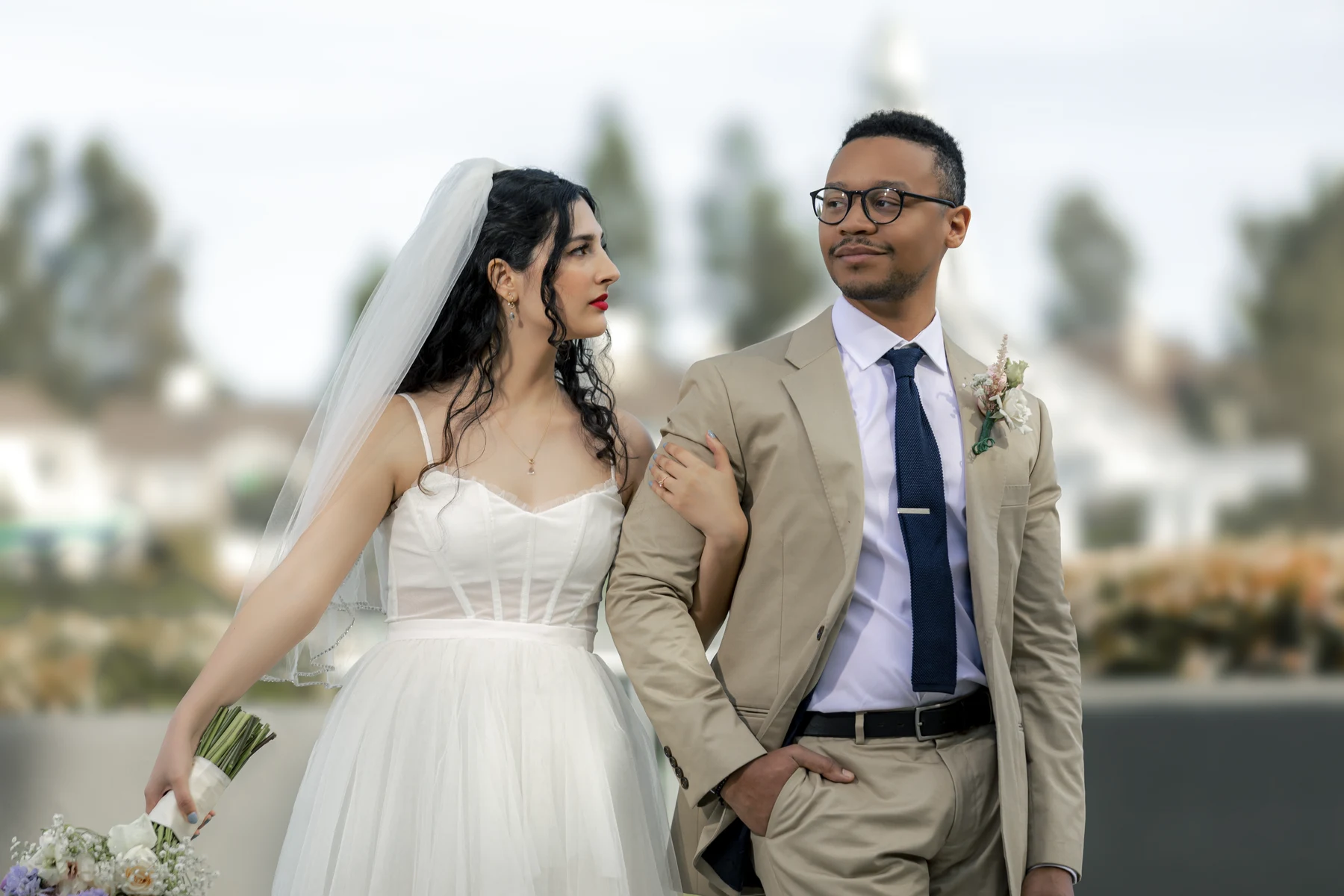
Couples ask me this at almost every consultation, usually a little sheepishly: what does a wedding photographer actually do all day at your wedding? Fair question. From the outside it looks like I walk around for eight to ten hours pressing a button. In reality, the camera is maybe a third of the job. The rest is reading light, running a timeline nobody else is watching, managing forty relatives, protecting your files and quietly fixing small problems before you ever hear about them. Here is the honest breakdown of a full Los Angeles wedding day from my side of the lens.
Quick note before we start: I've already written about the actual list of moments I photograph, from coffee cups to sparklers. This post is different. It's about the work, not the shot list, because that work is what you're really paying for.
The short answer: I'm doing nine jobs at once
On a typical 8-10 hour LA wedding, I'm switching between these roles, sometimes inside the same minute:
- Light scout — finding the one window, doorway or patch of open shade that will flatter you.
- Timekeeper — tracking how far behind schedule we are and where I can win the minutes back.
- Director — giving short, clear prompts during portraits so you never feel posed.
- Documentarian — staying invisible during the ceremony, toasts and the moments nobody planned.
- Crowd wrangler — running family formals so 25 groupings take 20 minutes, not an hour.
- Logistics partner — coordinating with your planner, DJ, officiant and venue manager.
- Detail stylist — arranging rings, invitations and shoes in a way that still looks like you.
- Problem solver — a missing boutonniere, a broken zipper, a grandfather who needs a chair.
- Data guardian — dual-card recording, backups and making sure not a single file goes missing.
Let's walk through the day in order so you can see where each job shows up.
Before I ever walk in: the morning nobody sees
My wedding day usually starts two to three hours before I arrive. I charge and test every battery (I bring about twelve), format cards, clean sensors and pack two camera bodies, so if one fails mid-vows, the other is already in my hand. I check the sun angle for your venue using a sun-tracking app. A Malibu bluff ceremony at 4:30 pm in October has the sun sitting low over the water and straight into your guests' eyes; a Pasadena estate garden at the same time is already in soft shade from the oaks. Knowing that before I arrive changes where I'll stand and where I'll suggest the officiant positions you.
I also re-read your timeline and your shot list one more time, and I text your planner or point person to confirm the getting-ready location and parking. In LA, parking alone can eat 20 minutes at a downtown hotel. That's why I believe your photographer should arrive well before you get dressed, not at the moment you step into the gown.
Getting ready: reading the room and the window light
When I walk into the bridal suite, the first thing I do is not take a photo. I look at the windows. Most hotel rooms in Santa Monica or Beverly Hills have one good wall of light and a lot of yellow lamps. I'll turn off the overhead lights (you'd be amazed how often nobody has), move the clutter of garment bags and takeout boxes out of frame, and figure out where you should sit for the final touches of makeup so the light is falling across your face instead of from the ceiling.
Then I start working quietly: details first (dress, shoes, rings, invitation suite, perfume, the letter from your partner), then candids of the room, then the dress-on moment. That last part is a good example of the hidden job. I'm watching the clock because hair and makeup run behind at most weddings I shoot, often by 20-40 minutes. If it slips, I'm the one who tells the planner early so we can shorten something later rather than lose portraits at sunset.
I'll be blunt: getting ready is where weak photographers lose the day. They shoot hundreds of frames of a messy room in bad light and then have nothing left in the tank later. I'd rather take 150 great frames here than 600 average ones.
First look and couple portraits: I become a director
If you're doing a first look, I've usually scouted the spot within minutes of arriving: a quiet courtyard, a covered walkway, somewhere with open shade and no guests peeking. I'll position your partner, cue you in, and then step back and let it happen. My job in that minute is to stay out of the way and anticipate the reaction.
Portraits are where I'm most active. Most people aren't models, and that's fine. Instead of saying "pose," I give prompts: walk toward me and talk about something only you two know, put your forehead to theirs and breathe out, whisper the worst joke you've got. Those small prompts produce real expressions. I'm also constantly adjusting: moving you two feet to the left so a palm tree isn't growing out of your head, turning you so the sun is behind you and not in your eyes, checking that your veil isn't caught on your shoulder.
Honestly, I think the best portrait session is a short one. Twenty to thirty minutes before the ceremony and another 15-20 at golden hour beats one exhausting hour where you miss your cocktail hour. In LA, golden hour light lasts a frustratingly short time, so the second session is planned to the minute.
The ceremony: invisible, silent and in three places at once
During the ceremony I switch completely from director to documentarian. I don't speak, I don't direct, and I don't stand in the aisle. I'll have talked to your officiant beforehand about where I'm allowed to stand (some churches and synagogues have strict rules) and about stepping aside for the kiss so I'm not shooting the back of their head.
In 25 minutes I'm covering the processional, your partner's face as you walk in, the parents in the front row, the ring exchange, the kiss and the recessional. I move during the readings, never during vows. I shoot silent shutter. And I'm watching for the things you'll miss: your dad wiping his eyes, the flower girl sitting down mid-aisle, your best friend mouthing the vows along with you.
This is also where one team pays off. At ConneryFilm, photography and cinematic video come from one studio under one roof, so my photographer and my cinematographer have already agreed who stands where. Two separate vendors who met that morning will often end up in each other's shots or fighting for the same angle at the altar.
Family formals: crowd control with a smile
Right after the ceremony is the least glamorous and most important logistics job of the day. Family photos. A typical LA wedding has 15-25 groupings, and every one of them involves finding Uncle Ray, who has already gone to the bar.
Here's what I actually do:
- Work from your list in an order that builds and breaks groups efficiently (big group first, then peel people off), so grandparents can sit down early.
- Ask you for one loud, well-connected family member on each side to fetch people. That one assignment saves 10-15 minutes.
- Pick a spot in even shade, with the sun behind the group, so nobody squints.
- Check every frame on the back of the camera for closed eyes and take two or three of each grouping.
Done right, 20 groupings take about 20-25 minutes. Done badly, it takes an hour and your cocktail hour disappears.
Cocktail hour, reception and the stuff that isn't on the timeline
While you're finishing portraits, I or my second shooter are photographing the reception room before guests walk in: tables, florals, cake and the room from a high angle. Once guests are seated, the room never looks that clean again.
At the reception my role shifts again. I coordinate with the DJ or band so I know exactly when the entrance, first dance, toasts, parent dances and cake cutting are happening. I'll ask them to give me a 30-second heads-up, because a toast that starts while I'm in the restroom is a toast that's gone forever. I set up off-camera flash on light stands during dinner so the dance floor looks clean and dimensional instead of flat and orange.
Then I spend a lot of time just watching. Reception candids are about anticipation: the grandmother who is about to get pulled onto the dance floor, the groomsman who is about to cry during his own toast. Most of my favorite frames from any wedding come from moments nobody planned.
As for how long I stay: most couples need me for 2-3 hours of the reception, which is enough to cover all the main events plus open dancing. I've written separately about how long photographers usually stay into an LA reception if you're deciding whether to add hours.
The quiet job running all day: protecting your files
Most photographers won't say this, but the scariest part of my job isn't missing a shot. It's losing one. So all day long I record to two memory cards at once in each camera. Full cards never leave my body; they go into a zipped pouch on my belt, not into a bag sitting at a table. When I get home, often after midnight, the first thing I do is copy everything to two drives before I sleep. That's the boring, unglamorous work that means a camera failure is a non-event instead of a disaster.
What happens after I leave
The wedding day is only part of it. A full 8-hour wedding takes me around 40-60 hours from first consultation to final gallery: culling 3,000-5,000 frames down to 600-900, color-grading every image, retouching key portraits and building the gallery. If you're curious where the rest of those hours go, I broke it down in how many hours a wedding photographer really works. Sneak peeks typically go out within 48 hours and full galleries in four to six weeks.
What I'd ask for if it were my wedding
- A realistic timeline with 15-minute buffers before the ceremony and before golden hour.
- One family helper on each side with the formals list on their phone.
- A photographer and videographer who work together, not two strangers.
- Two short portrait sessions instead of one long one.
- At least 8 hours of coverage for a full LA wedding with getting ready and reception. Photography with ConneryFilm starts at $1,599, and photo and film together start at $3,500. For small weddings under 60 guests, four hours of photography starts at $899.
And if you're thinking about engagement photos, our standalone engagement shoot is $1,800 and isn't part of any package, but book Photography & Cinematography by December 31, 2026 and it's included free. Details are on the offer page.
FAQ
Does a wedding photographer take breaks during the day?
Yes, usually one short meal break during dinner service, when guests are eating and nothing photogenic is happening. Ask your planner to feed your photographer at the same time as your guests so they're back before the toasts.
Do I need a second shooter at my LA wedding?
For weddings over about 120 guests, or when both partners get ready in separate locations, yes. A second shooter covers the other side of getting ready, the ceremony from a second angle and candids during cocktail hour while the lead photographer is with you.
Will my photographer tell guests where to stand?
During family formals, yes, politely and firmly. During the ceremony and reception, no. A good wedding photographer directs during portraits and stays invisible during real moments.
How many photos does a photographer take in a day?
On an 8-10 hour LA wedding I take 3,000-5,000 frames and deliver around 600-900 fully edited images. Most of the cut ones are duplicates, closed eyes or test frames.
What should I tell my photographer before the day?
Your timeline, the names of key family members, any family sensitivities (divorced parents, a relative who shouldn't be in a group shot), venue rules and the five or six photos that matter most to you. That short conversation saves more time than any long shot list.
If you're planning a Los Angeles wedding and want a team that handles all nine of those jobs so you can just be present, I'd love to hear about your day. Call or text 818.749.7039, or take a look at our work and packages at ConneryFilm.com. Tell me your date and venue and I'll tell you honestly how I'd plan the light and the timeline.
Meet the Author: Connery Davoodian Hello, I'm Connery Davoodian, the visionary behind ConneryFilm, and I'm thrilled to share insights from my 17-year journey through the world of wedding photography and videography. My passion extends beyond simply capturing images; it's about artfully weaving your unique love story into a timeless, cinematic masterpiece. My artistic path began long before I ever picked up a camera, deeply rooted in music as a singer, songwriter, and multi-instrumentalist. This diverse background in directing, producing, and editing has cultivated a unique perspective, allowing me to approach each wedding not just as an event, but as a dynamic narrative waiting to be beautifully told. This blend of technical mastery and creative storytelling is the heartbeat of ConneryFilm, ensuring that every frame, every shot, and every film is infused with depth, emotion, and unparalleled artistic integrity. At ConneryFilm, we believe your wedding memories deserve nothing less than bespoke luxury. My philosophy centers on capturing the authentic, unscripted moments – the genuine smiles, the tender glances, the joyful laughter – that truly define your day. While we obsess over exquisite details and sophisticated aesthetics, our true joy comes from making you feel completely at ease, like a "friendor" who genuinely celebrates alongside you. This calm, organized presence allows your true personalities to shine, resulting in images and films that are as real and vibrant as your love itself. Based in the heart of Los Angeles, California, my team and I are privileged to serve couples across the globe, bringing our signature high-end wedding photography and videography to destination weddings worldwide. Through these blog posts, I aim to share invaluable insights, luxurious inspiration, and practical, fun advice to guide you through your wedding planning journey, helping you make informed decisions about preserving your most cherished moments. Thank you for trusting ConneryFilm to be a part of your extraordinary adventure. I'm excited to share my knowledge and passion with you, helping you create memories that will last forever.