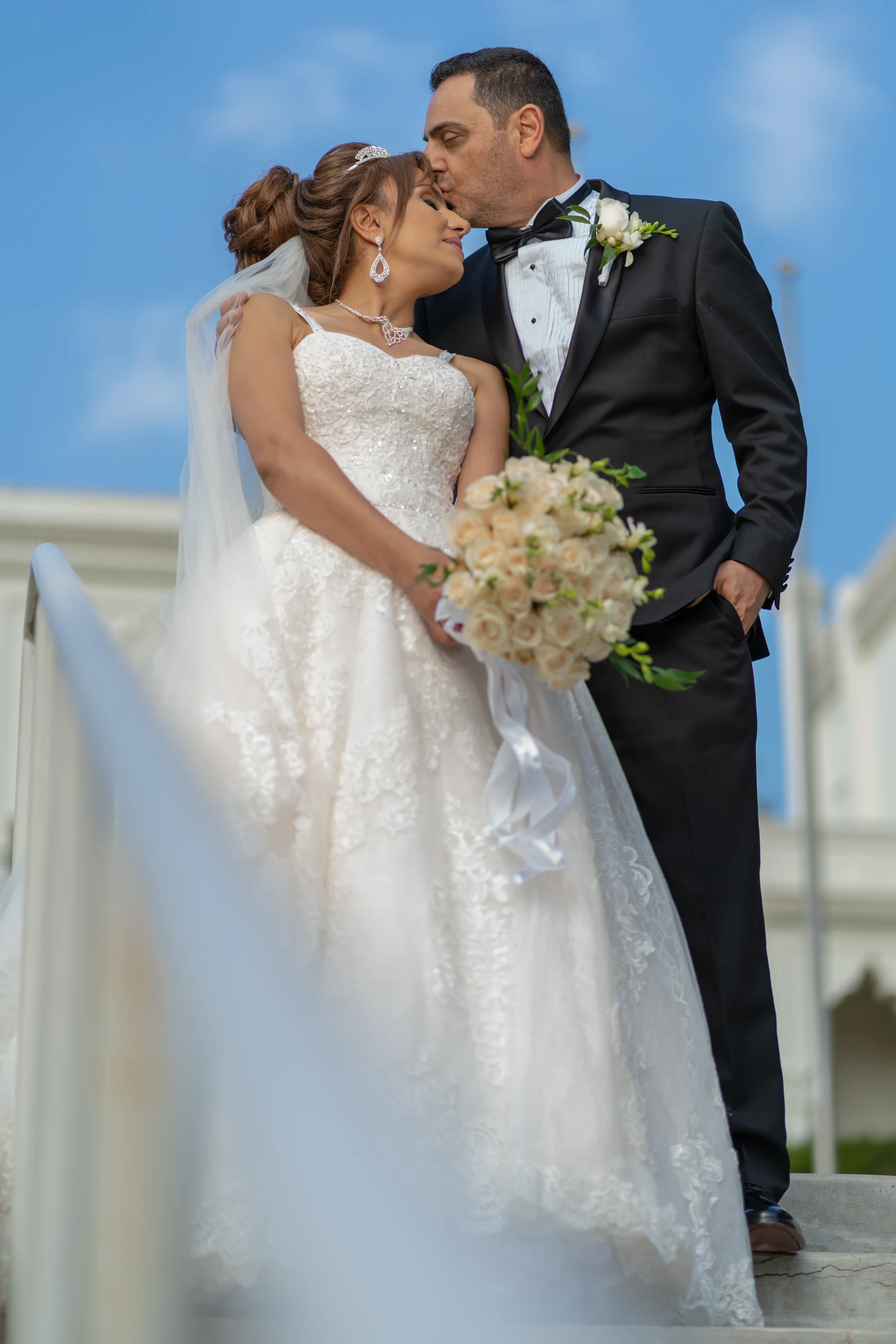
If you've ever watched a wedding photographer work a ceremony and wondered why they look like they're wearing a gun holster, here's the short answer to why wedding photographers have two cameras: so we never have to change lenses during a moment that only happens once, and so a single broken camera can't end your coverage. That's it. Speed and insurance. Everything else is detail.
I've been photographing and filming weddings around Los Angeles for 17 years, and I've carried two bodies on my hips at every single one of them. Not because it looks professional. Because I've seen what happens when someone doesn't.
The ceremony that convinced me
Early in my career I second-shot for a photographer who worked with one camera and a bag of lenses. Beautiful work, honestly. The ceremony was at a garden estate in Encino, late afternoon, and she had a 70-200mm on for the vows from the back of the aisle. The officiant wrapped up faster than anyone expected. She swapped to a wide lens to catch the recessional, the couple turned, the groom dipped the bride into a kiss nobody had planned, and she was still twisting the lens on.
She missed it. I got it from the side aisle, on my second body, at 35mm. That one frame ended up as the couple's album cover.
A lens change takes four to eight seconds if you're fast and nothing goes wrong. A first kiss lasts about three. That math is the whole reason two cameras exist.
Reason one: two focal lengths, ready at the same instant
Most of my wedding day runs on two lenses mounted on two bodies at once. My usual pairing is a 35mm on one side and an 85mm on the other. During the ceremony I'll often swap the 85 for a 70-200mm so I can stay out of the aisle and still fill the frame with faces.
Here's what that actually buys you:
- The tight and the wide of the same moment. When your dad's voice cracks during the toast, I want his face filling the frame on the 85 — and one second later, the whole table laughing at him on the 35. Those are two different photographs, and you want both.
- No sensor dust. Every lens change opens the camera to the air. At a Malibu beach ceremony or a windy Palos Verdes bluff, that's sand and salt going straight onto the sensor. Dust spots on a sensor show up in every frame after that until someone cleans it. Two bodies means I barely change lenses all day.
- Less fumbling, more watching. The less time I spend with my head down in gear, the more time I spend reading the room. That's where the real photos come from.
I'll be blunt: the camera matters far less than people think. I wrote about that in which camera is actually best for weddings, and it's still true. But having two of them matters more than which brand they are.
Reason two: a camera will fail at some point. Plan for it.
Cameras are machines. Shutters wear out. Batteries die in the cold desert air at a Joshua Tree elopement. A body gets knocked off a reception table by an enthusiastic uncle on the dance floor (yes, that happened to me at a ballroom in Downtown LA, and no, I didn't let him buy me a new one).
When you have one camera and it dies at 5:40 PM, your ceremony coverage ends at 5:40 PM. When you have two, I grab the other body and keep shooting. You'd never know anything happened.
Most photographers won't say this out loud, but I'll say it: a wedding photographer who shows up with one camera body is gambling with your wedding. I don't care how good their portfolio is. You only get the day once, and a second body costs a working photographer maybe $1,500-$2,500 used. That's a cheap insurance policy for them, and a non-negotiable one for you.
Reason three: dual memory cards are the other half of the backup
Two cameras protect you against a hardware failure. Two card slots protect you against a data failure. Every body I bring writes every frame to two memory cards at the same time. If a card corrupts — and over 17 years I've had exactly two do it — the identical file is sitting on the other card.
So when you ask "why two cameras?", the full professional answer is really: two bodies, each with two cards, plus spare batteries, plus a backup flash. Then the files are copied to three places that night. If you want the whole list, I broke down what's actually in a wedding photographer's bag piece by piece.
Why not just use one zoom lens?
Fair question. A 24-70mm zoom covers wide and medium, so why not one camera with one zoom?
A couple of reasons. Zooms like the 24-70 typically open to f/2.8. My primes open to f/1.4 or f/1.8. That's more than a full stop of extra light, which matters enormously at a dark reception in a candlelit Hollywood Hills restaurant or a church in Pasadena that bans flash during the ceremony. It also gives you that soft background separation couples love.
And even with a zoom, you still can't be at 24mm and 135mm at the same time. The two-body setup gives me both ends instantly. Honestly, I think a photographer who only shoots one zoom all day tends to produce galleries where every photo looks like it was taken from the same distance. Variety in focal length is a big part of what makes a gallery feel like a story instead of a slideshow.
Two cameras is not the same as two photographers
Couples sometimes mix these up. Two cameras on one photographer gives you two focal lengths from one spot. A second photographer gives you two angles from two spots — the groom's face during the processional while I'm on the bride walking in.
Those solve different problems. For a lot of weddings under 150 guests, one photographer with two bodies covers it beautifully. I wrote a frank piece on when a second photographer isn't worth the money if you're trying to decide.
This is also where having photo and video under one roof helps. At ConneryFilm, my photographers and cinematographers work as one team. We plan positions together before the ceremony, so the film camera and the photo cameras aren't standing in each other's shots, and a cinematographer at the front of the aisle effectively gives you a second angle on the processional without anyone stepping on anyone. Two separate vendors who met that morning rarely coordinate that well. Photography starts from $1,599, cinematography from $1,799, and photography plus cinematography together from $3,500.
What it looks like on the day
If you see me at your wedding, here's what you'll notice:
- A dual harness, with one camera on each hip. Not a neck strap — after 10 hours, a neck strap wrecks your back and swings into guests.
- The wide lens on my left, the longer lens on my right. Always the same sides, so I can grab the right one without looking.
- During portraits at golden hour, usually the 85mm doing most of the work. LA's golden hour lasts about 25 minutes in late summer, and I'm not spending any of it changing lenses.
- During the dance party, the wide lens with a flash on top, getting in close.
You won't notice it much. That's the point. It's built so I disappear into the day and still catch everything.
Questions couples ask me about this
Should I ask a photographer how many cameras they bring?
Yes. Ask how many camera bodies they bring and whether each one records to two memory cards. The right answer is at least two bodies, both with dual card slots. Any hesitation on that question is a red flag.
Does a photographer with two cameras deliver more photos?
Not necessarily more, but more varied. For an 8-hour Los Angeles wedding I typically deliver 500-800 edited images, and the two-body setup means more of them are different focal lengths of the same moment rather than near-duplicates.
Are both cameras the same model?
Ideally, yes, or at least the same brand and generation. Matching bodies means matching color and identical controls, so I'm not hunting for a button in the dark. It also makes editing faster because the files match.
Do wedding videographers also use two cameras?
They usually use more. A proper ceremony film runs two or three cameras at once — one wide and locked off, one on the couple, one on reactions — plus separate audio recorders on the officiant and the groom. One camera simply can't capture vows and reactions together.
Is a second camera really necessary for a small wedding?
Yes. A 30-guest courthouse wedding has the same once-only moments as a 300-guest ballroom. Gear failure doesn't care about headcount.
If you're planning a Los Angeles wedding and want a team that shows up with backups for the backups — and photographers and filmmakers who actually plan your day together — I'd love to hear about it. Call or text 818.749.7039, or take a look at our work and packages at ConneryFilm.com. Tell me your date and your venue, and I'll tell you exactly how we'd cover it.
Meet the Author: Connery Davoodian Hello, I'm Connery Davoodian, the visionary behind ConneryFilm, and I'm thrilled to share insights from my 17-year journey through the world of wedding photography and videography. My passion extends beyond simply capturing images; it's about artfully weaving your unique love story into a timeless, cinematic masterpiece. My artistic path began long before I ever picked up a camera, deeply rooted in music as a singer, songwriter, and multi-instrumentalist. This diverse background in directing, producing, and editing has cultivated a unique perspective, allowing me to approach each wedding not just as an event, but as a dynamic narrative waiting to be beautifully told. This blend of technical mastery and creative storytelling is the heartbeat of ConneryFilm, ensuring that every frame, every shot, and every film is infused with depth, emotion, and unparalleled artistic integrity. At ConneryFilm, we believe your wedding memories deserve nothing less than bespoke luxury. My philosophy centers on capturing the authentic, unscripted moments – the genuine smiles, the tender glances, the joyful laughter – that truly define your day. While we obsess over exquisite details and sophisticated aesthetics, our true joy comes from making you feel completely at ease, like a "friendor" who genuinely celebrates alongside you. This calm, organized presence allows your true personalities to shine, resulting in images and films that are as real and vibrant as your love itself. Based in the heart of Los Angeles, California, my team and I are privileged to serve couples across the globe, bringing our signature high-end wedding photography and videography to destination weddings worldwide. Through these blog posts, I aim to share invaluable insights, luxurious inspiration, and practical, fun advice to guide you through your wedding planning journey, helping you make informed decisions about preserving your most cherished moments. Thank you for trusting ConneryFilm to be a part of your extraordinary adventure. I'm excited to share my knowledge and passion with you, helping you create memories that will last forever.