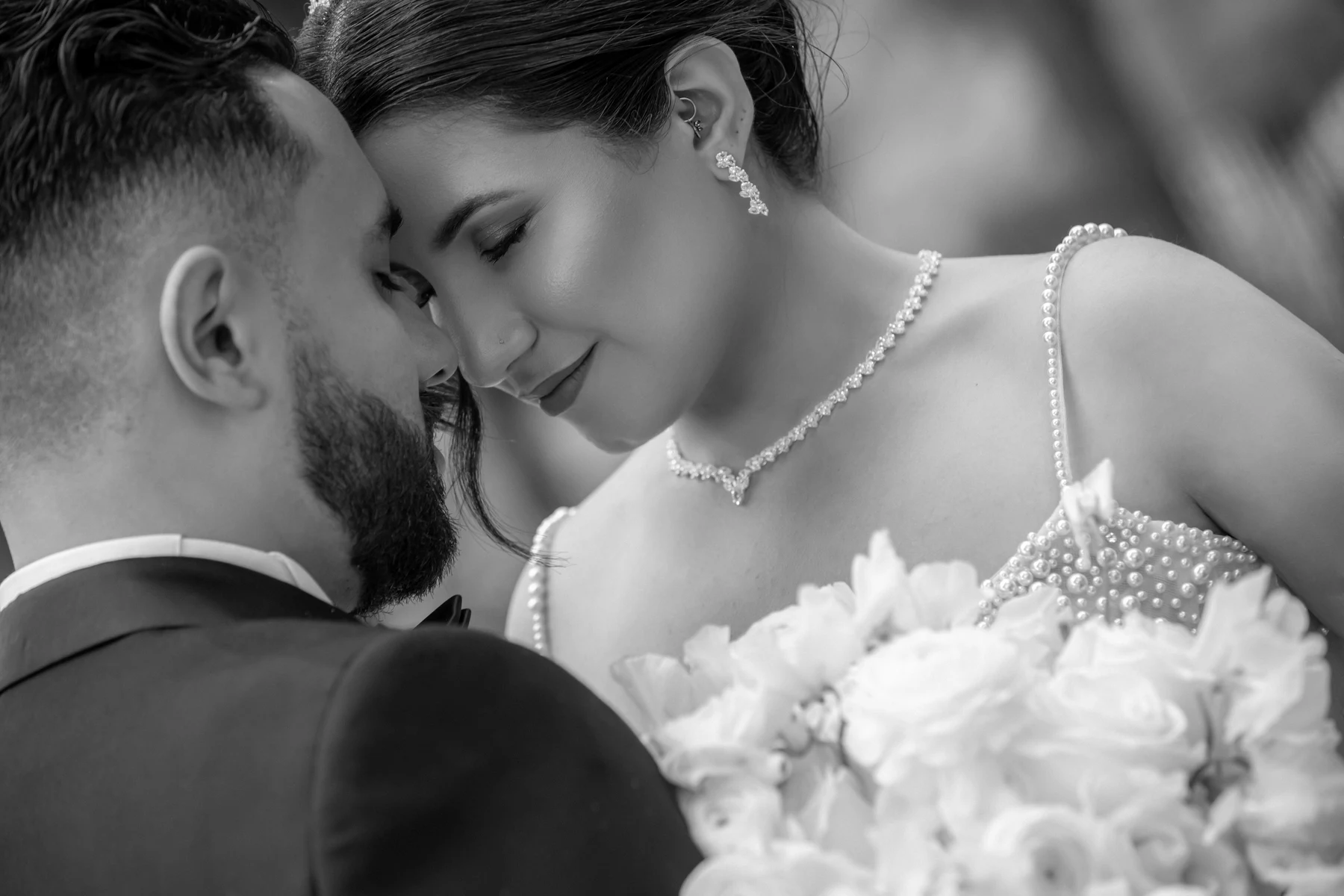
I get asked about the best wedding photography settings in two very different ways. One is a couple at a consultation in Pasadena who want to know whether their cousin with a new Sony can pull off the ceremony. The other is a second shooter on their first job with me, standing in a hotel room in Santa Monica at 11 a.m., asking what to dial in. My answer is the same for both: there is no single best setting. I run five different setups across a Los Angeles wedding day, and I switch between them without thinking because each one is built for a specific kind of light and a specific kind of moment. Here is all five, with the actual numbers.
The blunt answer before the long one
If you want one baseline to start from, it is this: f/2, 1/250, Auto ISO with a ceiling at 6,400, RAW files on two cards writing at the same time, continuous autofocus with eye detection on. That is my resting state. I wrote a whole post on the settings I actually use most of the day, and that baseline covers maybe 60 percent of a wedding on its own.
But the other 40 percent is where weddings get lost. The processional in a dim church in Glendale. The dance floor at a warehouse in the Arts District when the DJ kills every light except a strobe. The couple's portraits on a bluff in Malibu with the sun two fingers above the water. The baseline does not survive any of those. Five setups do.
Setup 1: Getting ready, window light
Most getting-ready rooms in Los Angeles are hotel suites or Airbnbs with one good window and a lot of warm overhead bulbs. I turn the overheads off the moment I walk in. Mixed light is the number one cause of orange skin in getting-ready photos, and no setting fixes it later.
- Aperture: f/2 to f/2.8. Wide enough to melt a messy room, not so wide that I lose the second eye on a close portrait.
- Shutter: 1/250. Fast enough for hands moving through hair and makeup, slow enough to keep ISO sane.
- ISO: Auto, capped at 6,400. A north-facing window in Beverly Hills at 10 a.m. usually lands me around ISO 800 to 1,600.
- White balance: Daylight, around 5,200K. Never auto in a room with a window, because auto drifts every time someone walks past it.
- Shutter type: Mechanical, not silent. Silent shutters band under the LED strips in most hotel bathrooms.
I move the bride to within six feet of the window for the dress and the jewelry. Beyond that, the light falls off fast and ISO climbs for no reason.
Setup 2: The ceremony, where the light changes mid-sentence
The ceremony is the one part of the day I cannot redo, so this setup is built for safety over style. Two bodies, two different setups, and I pick up whichever matches the moment.
For an indoor or church ceremony, the body with the 70-200mm is at f/2.8, 1/500, Auto ISO up to 12,800. The faster shutter is for the processional, because people walk faster than they think they do, and 1/250 gives me soft feet and soft hands on the father of the bride. Silent shutter goes on here, because a church in San Marino echoes, and a mechanical shutter during the vows is a sound the couple will remember.
For an outdoor ceremony, the problem flips. A 2 p.m. ceremony on a lawn in Calabasas is brutal: full sun, white dress, dark suit, all in one frame. I go to f/4, 1/2,000, ISO 100, and I expose for the dress. The suit can come back in editing. A blown-out dress cannot. I covered the full list of fixes in what I do about harsh midday sun, and the short version is that settings are the last tool, not the first. Position comes first.
Setup 3: Golden hour portraits
This is the setup everyone imagines when they search for the best wedding photography settings, and it is the one I spend the least time thinking about, because the light is doing the work.
- Aperture: f/1.4 to f/2 on the 50mm or 85mm. This is where wide apertures earn their price.
- Shutter: 1/1,000 to 1/4,000. Backlit sun is bright even when it feels soft.
- ISO: 100. Base ISO, always, for the 25 minutes that matter.
- Metering: Highlight-weighted or spot on the face. The camera's default meter sees the sun and tries to make the couple a silhouette.
- White balance: Cloudy, around 6,000K, to keep the warmth the camera wants to strip out.
The setting that matters most here is not on the camera. It is the clock. In Los Angeles, usable golden hour at a beach or a rooftop runs about 25 minutes, and if the timeline puts dinner at that time, no aperture saves it. I build every timeline around sunset minus 90 minutes for exactly that reason.
Setup 4: Family formals, the one nobody thinks about
Here is a stance I will commit to: family formals are the most technically demanding ten minutes of a wedding, and they are where I see the most expensive mistakes from photographers who shoot everything at f/1.8.
A group of twelve people in two rows needs depth of field. At f/1.8, grandma in the back row is soft, and she is the one person in that photo who will not be in the next one. My formals setup is f/4 to f/5.6, 1/250, ISO 400 to 800, on a 35mm. If the formals are in open shade at a venue in Topanga, that is enough. If they are indoors, I add one flash bounced off a white ceiling or a wall, dialed to a quarter power, so everyone's eyes have the same catchlight and nobody has a shadow across their face from the person beside them.
It is the least glamorous setup on this list and the one I would never skip. If your photographer only talks about bokeh, ask them what aperture they use for your parents' photo.
Setup 5: The reception, where I drag the shutter
Receptions in LA fall into two groups. Venues with real ambient light, like a string-lit courtyard in Los Feliz, and venues with none, like a ballroom at 9 p.m. when the uplighting is purple and the DJ has fog going. Both get flash. The difference is how much.
My reception setup starts at f/2.8, 1/200, ISO 3,200, with one flash on camera bounced behind me and a second flash on a stand in a far corner of the room, pointed back at the dance floor, at about an eighth power. The second light is what makes a dance floor photo look like a photo instead of a snapshot. It gives a rim of light on hair and shoulders that separates people from a black background.
Then, once the dancing is real, I drop the shutter to 1/30 or even 1/15, keep the flash, and spin the camera slightly as I shoot. The flash freezes the person. The slow shutter streaks the lights behind them. It is the one trick that turns a dark room into something that feels like the night did. I go deeper on the indoor side of this in my exact low-light settings, including the ISO ceiling that I will not cross.
One honest note on file size here: a dragged-shutter dance floor at 1/15 is a 30 percent keeper rate on a good night. That is fine. I am shooting for the three frames that work, and the couple never sees the twenty that do not.
The settings that matter before the day starts
Most photographers will not say this, but the settings that save a wedding are not exposure settings at all. They are the ones you set once, in the car, and never touch:
- RAW, both cards, simultaneous write. A card failure at a wedding in Malibu cost a photographer I know a ceremony. Two cards would have cost him nothing.
- Back-button focus. The shutter button only takes the picture. Focus lives on my thumb, so a guest walking through the frame does not pull focus off the couple.
- Continuous autofocus with eye detection, people priority. On, all day, both bodies. I have not used single-point focus at a wedding in four years.
- Auto ISO with a ceiling. Not auto everything, just ISO. I set aperture and shutter for the look and let ISO absorb the light changes. I explained exactly how I cap Auto ISO in a separate post, because it is the setting that changed how I shoot more than any lens.
- Clock synced on both bodies. Boring, and the thing that makes 4,000 photos sort in order the next morning.
What this means if it is your wedding
I will be blunt: if you are reading this to shoot a friend's wedding, settings will not carry you. Settings are maybe 20 percent of wedding photography. The rest is knowing where to stand, when the light turns, and what happens next before it happens. I have shot over 400 weddings in and around Los Angeles across 17 years, and I still walk every venue the week before.
If you are reading this because you are hiring, use it as an interview. Ask a photographer what they do when the DJ kills the lights. Ask what aperture they use for family formals. Ask whether they shoot to two cards. The answers tell you more than any portfolio.
One more thing from how I run my studio. At ConneryFilm, photography and film come from one team, under one roof, and that changes settings in a way couples never see. My video side lights a reception with soft, continuous LED panels that the stills side has already planned around, so my flash is never fighting a video light and the video is never fighting my strobe. When a couple hires a photographer and a separate videographer, I watch those two lighting plans argue with each other all night. One team, one lighting plan, one look across both the photos and the film.
Frequently asked questions
What is the single best setting for wedding photography if I can only remember one?
Aperture priority at f/2.8 with Auto ISO capped at 6,400 and a minimum shutter speed of 1/250. It will not be perfect at golden hour or on the dance floor, but it will not lose the ceremony either.
Should I shoot a wedding in manual or aperture priority?
I shoot manual with Auto ISO, which is manual for the look and automatic for the light. Pure manual at a wedding means missing frames every time you walk from a bright courtyard into a dim hallway. Pure aperture priority means the camera picks a shutter speed that blurs the processional.
What ISO is too high for wedding photos?
On a current full-frame body, 6,400 is clean for prints up to 16x24 inches, and 12,800 is fine for a 4x6 or a phone screen. My ceiling for the ceremony is 12,800. My ceiling for portraits that will be printed large is 1,600.
Do I need flash for an outdoor Los Angeles wedding?
For the ceremony and portraits, almost never. For the reception, yes, even outdoors. A string-lit patio in Silver Lake looks bright to your eyes and reads as ISO 12,800 at 1/60 to a camera. One bounced flash at low power fixes it without killing the mood.
What shutter speed do you use for the first dance?
1/60 to 1/125 with flash for the clean frames, then 1/30 with flash and a slight camera spin for the ones with motion in the background lights. Both are in every gallery I deliver.
If you are planning a Los Angeles wedding and want a team that already knows what the light does at your venue at every hour of the day, I would love to talk it through with you. Call or text 818.749.7039, or send a note through ConneryFilm.com, and we can look at your timeline and your venue together before you book anything.
Meet the Author: Connery Davoodian Hello, I'm Connery Davoodian, the visionary behind ConneryFilm, and I'm thrilled to share insights from my 17-year journey through the world of wedding photography and videography. My passion extends beyond simply capturing images; it's about artfully weaving your unique love story into a timeless, cinematic masterpiece. My artistic path began long before I ever picked up a camera, deeply rooted in music as a singer, songwriter, and multi-instrumentalist. This diverse background in directing, producing, and editing has cultivated a unique perspective, allowing me to approach each wedding not just as an event, but as a dynamic narrative waiting to be beautifully told. This blend of technical mastery and creative storytelling is the heartbeat of ConneryFilm, ensuring that every frame, every shot, and every film is infused with depth, emotion, and unparalleled artistic integrity. At ConneryFilm, we believe your wedding memories deserve nothing less than bespoke luxury. My philosophy centers on capturing the authentic, unscripted moments – the genuine smiles, the tender glances, the joyful laughter – that truly define your day. While we obsess over exquisite details and sophisticated aesthetics, our true joy comes from making you feel completely at ease, like a "friendor" who genuinely celebrates alongside you. This calm, organized presence allows your true personalities to shine, resulting in images and films that are as real and vibrant as your love itself. Based in the heart of Los Angeles, California, my team and I are privileged to serve couples across the globe, bringing our signature high-end wedding photography and videography to destination weddings worldwide. Through these blog posts, I aim to share invaluable insights, luxurious inspiration, and practical, fun advice to guide you through your wedding planning journey, helping you make informed decisions about preserving your most cherished moments. Thank you for trusting ConneryFilm to be a part of your extraordinary adventure. I'm excited to share my knowledge and passion with you, helping you create memories that will last forever.