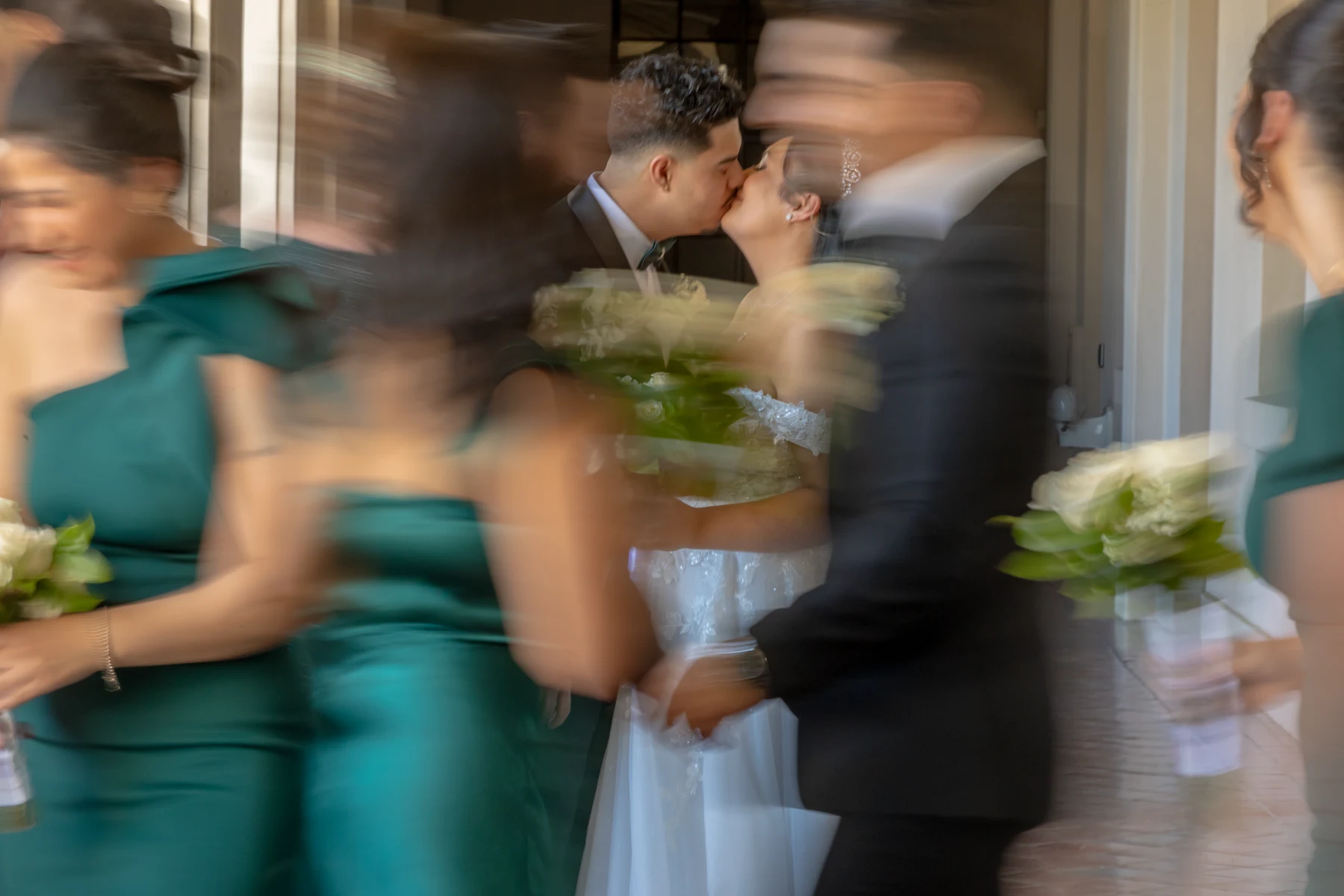
Short answer: yes. Black and white wedding photos are still popular, and in my studio they never really left. Every wedding I deliver in Los Angeles has a set of black and white frames in the gallery, and couples ask for more of them at almost every consultation. What has changed is how people use them. Ten years ago black and white was the "artsy" option you added to a few portraits. Now it is a deliberate part of how a gallery is built.
Why I think black and white is not a trend
I'll be blunt: trends are things that date a gallery. Heavy orange-and-teal grades, crushed faded blacks, filters that were everywhere for two summers. You can spot the year a wedding was shot from across the room. Black and white does not do that. A well-made black and white portrait from 1955 still works, and one I shoot this year will still work in 2055. That is the entire reason couples keep asking for it.
Popularity is a slightly different question from longevity, though. What I see is steady demand rather than a spike. Couples who want a timeless gallery ask for it up front. Couples who think they don't care about it end up loving a handful of frames they didn't expect. Almost nobody tells me afterward that they wish there were fewer.
Where black and white earns its place in a Los Angeles wedding
Not every moment suits it. Here is where I reach for it without thinking:
- Emotional moments. A father seeing his daughter for the first time, a groom wiping his eyes during the vows, a grandmother laughing. Remove the color and your eye goes straight to the expression.
- Mixed or ugly light. Reception rooms with warm tungsten bulbs, green LED uplighting and a pink DJ wash all at once will give you skin tones that fight each other. Converting to black and white fixes that cleanly.
- Harsh midday sun. A ceremony at noon at a Malibu or Santa Barbara estate gives hard shadows. Black and white handles contrast much better than color does. I wrote more about that in my piece on harsh midday sun at LA weddings.
- Busy backgrounds. A colorful mural downtown, a crowded patio, a clashing set of bridesmaid dresses. Take the color out and the people stand forward.
- Dance floor energy. Motion, sweat, flying hair, big laughs. Black and white makes that chaos look like a film still.
Where I leave it in color
Honestly, I think the biggest mistake is converting a whole gallery. Los Angeles light is one of the best things you are paying for. The pink and gold twenty minutes before sunset on a beach, the green of a garden venue in spring, the bridal bouquet, the bridesmaid dresses you spent months choosing. Stripping all of that out wastes the place you chose. If you want the sunset, read my guide to building a golden hour timeline, and keep those frames in color.
My rule is simple. Color for the scene, black and white for the feeling. In a typical delivered gallery of around 600 photos, I will usually convert somewhere between a tenth and a fifth of them. That is a judgment call, not a formula, and I adjust it for the couple and the venue.
What good black and white actually looks like
This is where I see the most confusion, because "black and white" is not one setting. Clicking a filter and desaturating a color photo gives you something flat and gray. A proper conversion is edited on purpose:
- The tonal range is controlled so you get real, deep blacks and clean whites, with detail in between.
- Skin tones are adjusted before the conversion, since a red-heavy or yellow-heavy skin tone turns muddy in monochrome.
- Contrast is matched to the mood of the scene. A quiet getting-ready moment wants softness. A dance floor wants punch.
- Grain is used sparingly, only where it supports the image.
I also shoot with black and white in mind. I will expose and compose a frame knowing it is going to be monochrome, looking for shape, line and light rather than color. That is a different habit from shooting color and converting later. If you want to understand my full approach to this, I covered my reasons in why I shoot black and white wedding photos.
Black and white versus film and "moody" editing
Couples sometimes lump black and white in with other styles. It is worth separating them. Black and white is a choice of color treatment. Film-style, light and airy, and dark and moody are overall looks that apply to the entire gallery. You can have black and white frames inside any of them. If you are still deciding on an overall look, my breakdown of light and airy versus dark and moody editing will help you decide, and black and white will fit into whatever you pick.
What I'd do if it were my wedding
I would ask my photographer for a mix and stop worrying about the ratio. I would want black and white for the ceremony reactions, the parents, the first dance and the late-night dance floor. I would want color for the portraits at sunset, the ring and the details, and the venue. And I would ask to see a sample gallery that includes both, not just a highlight reel of ten images.
One more point that is easy to miss. If you hire a separate videographer, your black and white photos and your film may end up feeling like they came from two different weddings. That is one reason I like running photo and film as one team at ConneryFilm. The color decisions, the mood and the timing are made together, so the gallery and the film feel like the same day. If you are weighing it, the post on how wedding photo and video do two different jobs explains how the two fit together.
A few practical notes for planning
- Ask early. Tell your photographer in the first meeting if you want a bigger share of black and white. It affects how they shoot, not just how they edit.
- Don't ask for both versions of everything. Delivering every photo twice dilutes the gallery. Pick the version that is stronger for each moment.
- Print choices. Black and white looks excellent as a large print or in an album. Matte paper suits it especially well.
- Check the portfolio. Ask to see black and white work from a full wedding, not only a few hand-picked portraits.
FAQ
Are black and white wedding photos still in style in 2026?
Yes. They are one of the few options that does not go out of style, and most couples I work with ask for at least a handful. The only shift is that people now use them selectively instead of converting everything.
How many black and white photos should be in a wedding gallery?
There is no required number. In a gallery of roughly 600 images, I usually convert somewhere around 10 to 20 percent, chosen by emotion and light rather than by quota. If you love the look, tell your photographer and the share can go higher.
Can you convert any color photo to black and white later?
Technically yes, but the best results come from frames that were shot with black and white in mind. If you want it, ask your photographer to edit the conversions properly rather than applying a one-click filter.
Is black and white better for weddings with bad lighting?
Often, yes. When a reception room has mixed warm and colored lighting, black and white removes the color conflict and keeps the focus on the people. It is one of the cleanest fixes available.
Will black and white photos look dated in 20 years?
Much less than heavy color grading will. Classic black and white has looked right for over a century, and a clean, well-exposed conversion keeps looking right.
If you are planning a Los Angeles wedding and want a gallery that mixes timeless black and white with the color of your day, I'd love to hear about it. Call or text 818.749.7039 or visit ConneryFilm.com and tell me what you're picturing.
Meet the Author: Connery Davoodian Hello, I'm Connery Davoodian, the visionary behind ConneryFilm, and I'm thrilled to share insights from my 17-year journey through the world of wedding photography and videography. My passion extends beyond simply capturing images; it's about artfully weaving your unique love story into a timeless, cinematic masterpiece. My artistic path began long before I ever picked up a camera, deeply rooted in music as a singer, songwriter, and multi-instrumentalist. This diverse background in directing, producing, and editing has cultivated a unique perspective, allowing me to approach each wedding not just as an event, but as a dynamic narrative waiting to be beautifully told. This blend of technical mastery and creative storytelling is the heartbeat of ConneryFilm, ensuring that every frame, every shot, and every film is infused with depth, emotion, and unparalleled artistic integrity. At ConneryFilm, we believe your wedding memories deserve nothing less than bespoke luxury. My philosophy centers on capturing the authentic, unscripted moments – the genuine smiles, the tender glances, the joyful laughter – that truly define your day. While we obsess over exquisite details and sophisticated aesthetics, our true joy comes from making you feel completely at ease, like a "friendor" who genuinely celebrates alongside you. This calm, organized presence allows your true personalities to shine, resulting in images and films that are as real and vibrant as your love itself. Based in the heart of Los Angeles, California, my team and I are privileged to serve couples across the globe, bringing our signature high-end wedding photography and videography to destination weddings worldwide. Through these blog posts, I aim to share invaluable insights, luxurious inspiration, and practical, fun advice to guide you through your wedding planning journey, helping you make informed decisions about preserving your most cherished moments. Thank you for trusting ConneryFilm to be a part of your extraordinary adventure. I'm excited to share my knowledge and passion with you, helping you create memories that will last forever.