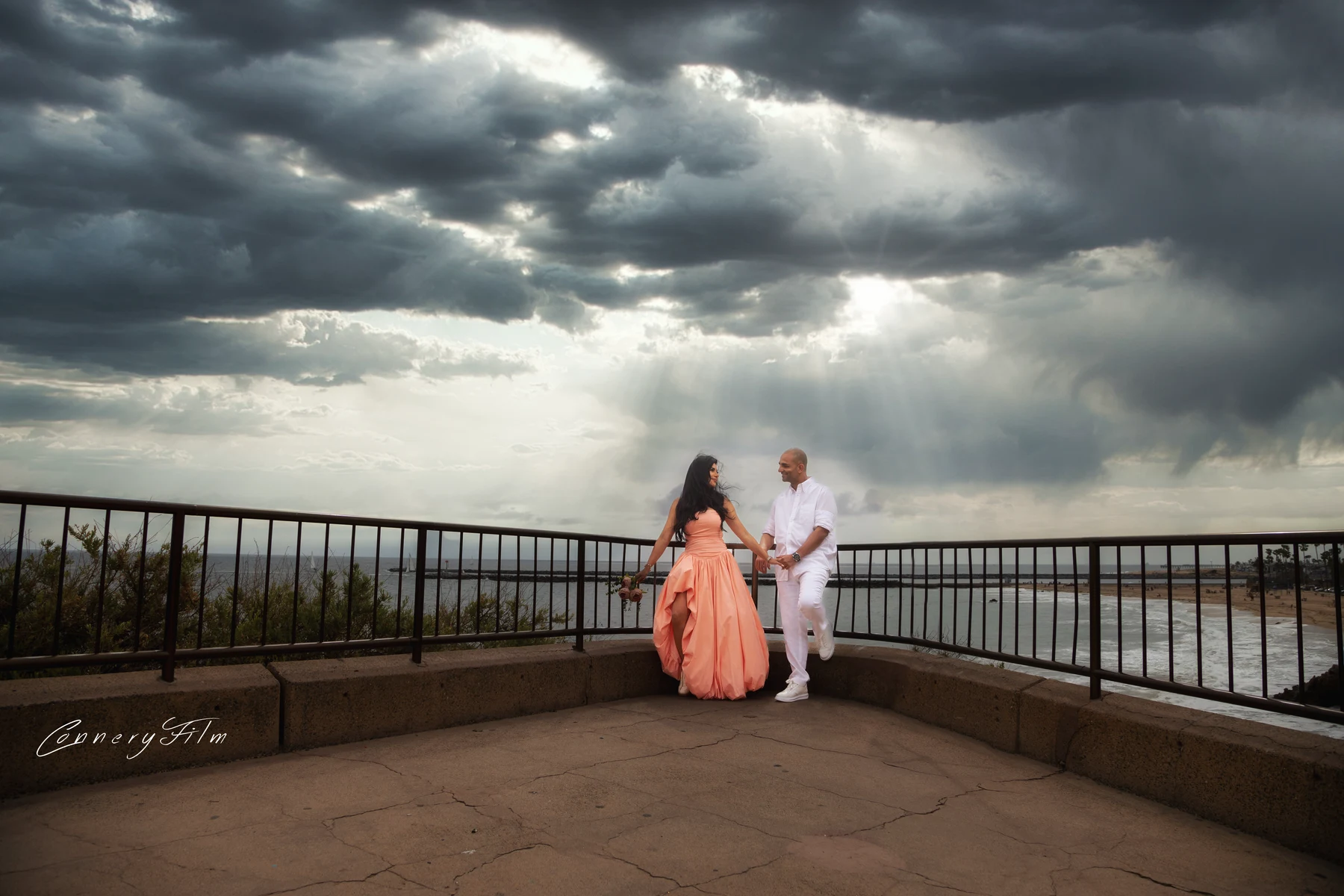
Documentary style wedding videography means I film your day as it actually happens and never stop it to stage a shot. No "can you walk back down the aisle one more time," no fake first look, no re-doing the toast because the audio was better on take two. I show up, I stay out of the way, and the film that comes back is the day you actually lived through — your mom's face during the vows, your best friend crying in the second row, the twelve seconds where you two are alone in a hallway and nobody is watching. In Los Angeles that approach has quietly become the thing most of my couples ask for by name, even when they don't know the word for it yet.
I've been shooting weddings for 17 years. Here's what the style actually is, what it is not, what it costs around LA, and the one thing that goes wrong with it more than anything else.
The short version: I'm a guest with a camera, not a director
Every wedding film falls somewhere on a line. At one end is the fully directed film — the videographer is running the day, calling out setups, asking you to hold hands and walk toward the light for the third time. At the other end is pure documentary: I film, I don't direct, and if a moment doesn't happen on its own it doesn't go in the movie.
Real documentary coverage in practice looks like this:
- Long lenses. I'm shooting your ceremony reactions from 40 feet back on a 70-200, not standing at the end of the aisle in your guests' sightline.
- Natural sound. Lav mics on both of you and on the officiant, a recorder on the DJ board, a shotgun mic on the camera for room tone. The audio is the whole ballgame — more on that below.
- Available light wherever it's possible. A small light on a stand at the reception when the DJ goes full purple, and that's it.
- Two cameras rolling continuously through the ceremony and toasts, because you cannot ask for a second take of a father-of-the-bride speech.
- No calling out directions. If I ask you for anything all day, it's probably "keep going" or "ignore me."
The edit follows the same rule. Documentary films are usually cut to your real voices — vows, toasts, a letter one of you wrote that morning — rather than to a licensed pop song with slow-motion running. That's the biggest tell between documentary and the glossy cinematic film that feels like a movie trailer. Both are legitimate. They're just doing different jobs.
I'll be blunt: most "documentary" videographers in LA are not shooting documentary
This word has been swallowed by marketing. I've sat with couples who booked a "documentary" film, and when I look at the vendor's actual portfolio it's forty minutes of staged golden-hour walking in Malibu cut to a Bon Iver track. That is a gorgeous thing to buy. It is not documentary. It's a directed lifestyle film with the word "documentary" on the pricing page because the word tests well right now.
There's an easy way to tell. Ask to watch a full film — not a 90-second Instagram edit, the whole 6-to-10-minute highlight and, if they offer it, a full ceremony cut. Then count two things: how many shots have the couple looking into the lens, and how much of the audio is real people talking versus music. In a genuinely documentary film, the couple almost never looks at the camera and you'll hear their actual voices for most of the runtime. If the answer is "nobody speaks and everyone is posing," you're buying something else. That's not a scam, but you should know what you're paying for before you sign. It's the same reason I tell couples to bring a real list of questions to the videographer meeting instead of just looking at the reel.
What it costs in Los Angeles
Documentary coverage is not cheaper than the cinematic stuff, and honestly it's sometimes more, because it needs more cameras rolling for more hours and far more audio gear. Around LA, here's where the real numbers sit in 2026:
- $2,800–$4,000 — one shooter, 6–8 hours, a 4–6 minute highlight film. Fine for a 60-guest wedding at a restaurant or a courthouse-plus-dinner day.
- $4,500–$6,500 — two shooters, 8–10 hours, highlight film plus the full ceremony and full toasts as separate documents. This is the sweet spot and where the majority of my documentary couples land.
- $7,000–$9,500 — two or three shooters, 10–12 hours, a 20–35 minute documentary edit, getting-ready coverage at two locations, raw footage delivered.
Add roughly $600–$900 for a second shooter if a package doesn't include one, and expect $400–$800 for full raw footage on a drive. A 200-guest Saturday at an estate in Calabasas or a hotel ballroom downtown almost always needs the two-shooter tier — one camera cannot be at the back of a 200-person ceremony and on your face at the same time.
Turnaround is longer than photo, always. Documentary edits mean syncing four or five audio sources and listening to every minute of it, so 8–12 weeks is normal in this city and my studio runs 8–10. If a vendor promises two weeks, they are not cutting to your real audio. I wrote out why wedding video takes as long as it does if you want the full breakdown.
The thing that ruins documentary films: audio
Every disaster I've seen in this style traces back to sound. A directed film can hide bad audio behind music. A documentary film cannot — it is the audio.
Real examples from real Saturdays in LA. A beach ceremony in Malibu at 4 PM where the onshore wind came up and the officiant's mic had no windscreen: forty minutes of vows that sound like a hairdryer. A rooftop in DTLA where the venue refused to let anyone touch the house sound board, so the toasts were captured by a camera mic 30 feet away and every speech came back hollow. A Pasadena garden where the groom clipped his lav to his jacket pocket instead of his lapel and the fabric rubbed over it for the entire ceremony.
So when you interview videographers, ask exactly this: how many independent audio sources are you recording during the ceremony, and what's the backup if one fails? I want to hear a number of at least three. Anyone who says "I mic the groom" is one dead battery away from your vows being gone forever. And the vows are the part you'll actually rewatch — I've had couples tell me they've never once watched the whole film again, but they've played the 90 seconds of their own vows a dozen times.
What I'd do if it were my wedding
I'd book documentary coverage for the whole day and then give the photographer 20 minutes of directed portraits — and I'd ask the video team to keep rolling loosely through those portraits rather than to stage anything of their own. That way you get one honest film and one set of beautiful, intentional photographs, and neither one is compromising for the other.
This is the real argument for hiring photo and film from the same studio, which is how I built ConneryFilm: my photographers and my film team work off one timeline, one shot plan, and one read of the room. When they're two different companies, portrait time turns into a negotiation — the photographer wants you facing the light, the videographer wants a walking shot, and you spend your cocktail hour being pulled between strangers. Under one roof, my video team knows to hang back and film the in-between moments while the photographer directs. Nobody is in anyone's frame. You just get an extra ten minutes of your own party back.
One more piece of honest advice: documentary style rewards a day with things actually happening in it. If your wedding is a 40-person dinner with no first dance, no toasts and no ceremony readings, a documentary film will be quiet and short, and that's fine — but know it going in. The style captures what's there. It doesn't invent it. If you want the sweeping, invented-looking stuff, book the cinematic film and be happy with it; there's a reason six different wedding video styles exist in LA and no one of them is the correct answer.
Questions couples actually ask me about this
Is documentary the same thing as candid or journalistic?
Basically, yes. "Documentary," "journalistic," "photojournalistic" and "candid" all point at the same idea: unposed, unstaged, filmed as it happened. The difference between vendors using those words is execution, not philosophy. Judge the work, not the label.
Will I look bad if nobody is directing me?
This is the fear behind almost every version of this question, and the answer is no — because the camera is far away and you're not performing. People look strange on video when they're aware of being filmed and trying to seem natural. Documentary coverage works precisely because you forget it's happening by about the 20-minute mark. Every single time.
How long is a documentary wedding film?
The highlight runs 5–10 minutes, longer than a cinematic highlight because real speech takes longer than music. The full documentary edit, if you buy one, is usually 20–35 minutes. I also deliver the ceremony and the toasts as unedited multi-camera cuts, which is what your family will actually want in ten years.
Do I still need a videographer if I have a great photographer?
Different jobs entirely. Photos give you the frame you hang in the hallway; video gives you your grandmother's voice. I've never had a couple regret the film, and I have had several call me a year later asking whether any footage exists of someone who has since passed away. That call is the reason I push people toward video more than I push them toward anything else.
Can you shoot documentary at a church or synagogue with restrictions?
Usually, and this style is actually the best fit for it. Plenty of houses of worship around LA restrict where cameras can stand or forbid movement during the ceremony entirely. Since I'm already shooting from the back on long lenses with mics pre-placed, those rules cost me almost nothing. Send me the venue's policy sheet before the day and I'll plan around it.
If this sounds like the film you want, I'd love to hear about your day — the venue, the timeline, the people who matter most in it. Call or text 818.749.7039 and we can talk it through, or take a look at recent work over at ConneryFilm.com. Even if you end up booking someone else, I'll happily tell you what to ask them.
Meet the Author: Connery Davoodian Hello, I'm Connery Davoodian, the visionary behind ConneryFilm, and I'm thrilled to share insights from my 17-year journey through the world of wedding photography and videography. My passion extends beyond simply capturing images; it's about artfully weaving your unique love story into a timeless, cinematic masterpiece. My artistic path began long before I ever picked up a camera, deeply rooted in music as a singer, songwriter, and multi-instrumentalist. This diverse background in directing, producing, and editing has cultivated a unique perspective, allowing me to approach each wedding not just as an event, but as a dynamic narrative waiting to be beautifully told. This blend of technical mastery and creative storytelling is the heartbeat of ConneryFilm, ensuring that every frame, every shot, and every film is infused with depth, emotion, and unparalleled artistic integrity. At ConneryFilm, we believe your wedding memories deserve nothing less than bespoke luxury. My philosophy centers on capturing the authentic, unscripted moments – the genuine smiles, the tender glances, the joyful laughter – that truly define your day. While we obsess over exquisite details and sophisticated aesthetics, our true joy comes from making you feel completely at ease, like a "friendor" who genuinely celebrates alongside you. This calm, organized presence allows your true personalities to shine, resulting in images and films that are as real and vibrant as your love itself. Based in the heart of Los Angeles, California, my team and I are privileged to serve couples across the globe, bringing our signature high-end wedding photography and videography to destination weddings worldwide. Through these blog posts, I aim to share invaluable insights, luxurious inspiration, and practical, fun advice to guide you through your wedding planning journey, helping you make informed decisions about preserving your most cherished moments. Thank you for trusting ConneryFilm to be a part of your extraordinary adventure. I'm excited to share my knowledge and passion with you, helping you create memories that will last forever.