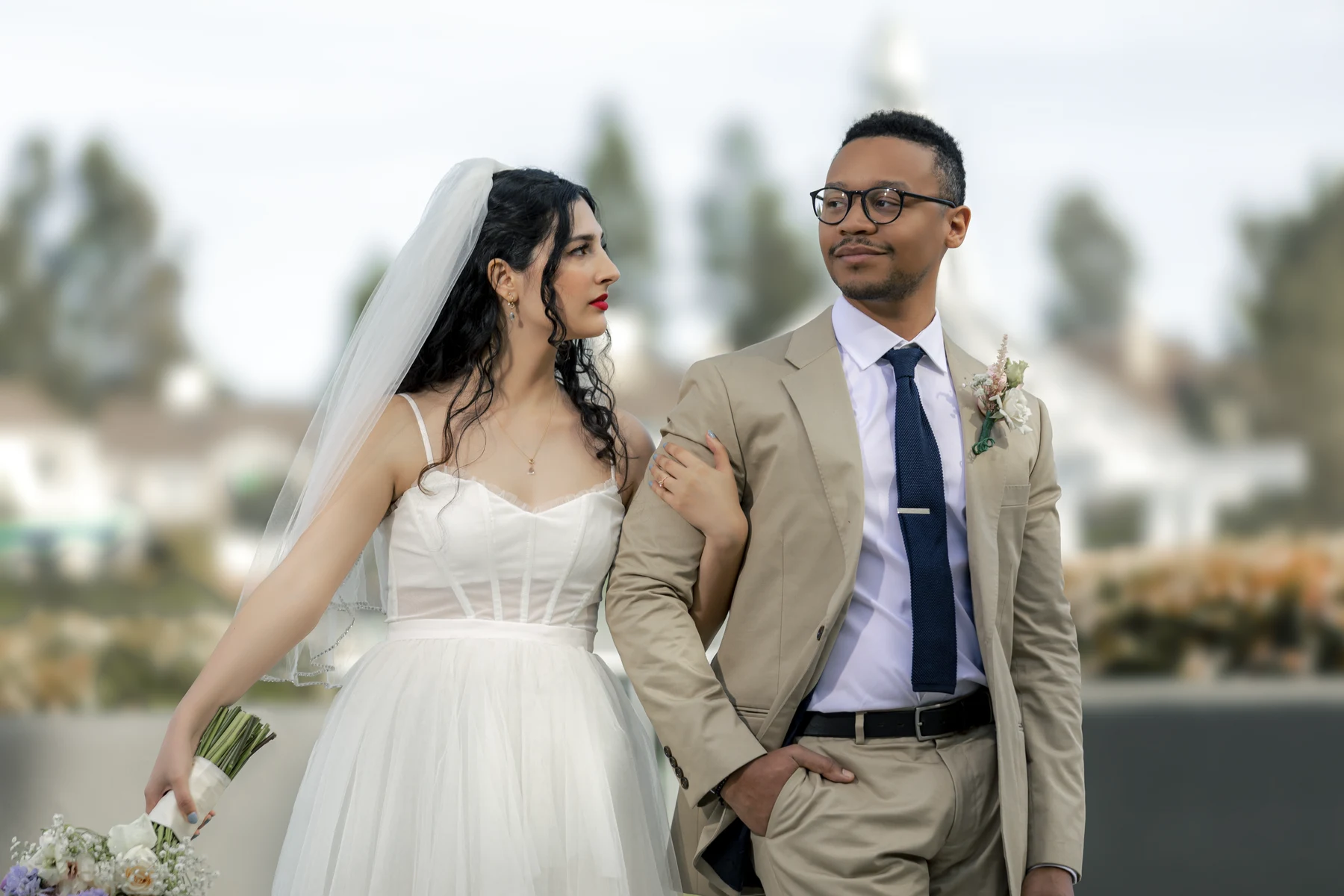
An unplugged wedding ceremony is one where guests put their phones, tablets and cameras away for the ceremony itself, so the only people photographing it are the professionals you hired. That's the whole definition. I recommend it to nearly every couple I meet, and after 17 years shooting weddings across Los Angeles, I'll be blunt: it's the cheapest way to improve your ceremony photos and video, and it costs you nothing but a small sign and a sentence from your officiant.
The moment I stopped being polite about phones
Years ago I shot a ceremony at a garden estate in the hills above Studio City. The bride came around the corner on her father's arm, the music swelled, and I raised my camera to catch her face as she saw her partner. Every single frame had a phone in it. Not one, a wall of them. Arms in the aisle, screens glowing, a guest in the second row actually stepped out into the walkway to get her angle. The expression on the groom's face, the one that couple will want to see in thirty years, is there, but it's framed by a dozen little rectangles.
I've never forgotten that gallery, because I had to hand it over. That's the day I started telling couples at consultations, plainly, that this is the one decision they can make that I can't make for them with a lens.
What "unplugged" actually asks of your guests
It's simpler than people expect. You're asking guests to do three things during the ceremony only:
- Keep phones and cameras put away from the processional through the kiss and the walk back down the aisle.
- Stay in their seats and out of the aisle, so the photographer and videographer have a clear line to you.
- Be present. Watch it with their own eyes, not through a screen.
After the ceremony, everything goes back to normal. Cocktail hour, family photos, the reception and the dance floor are all open season. Most couples I work with let guests post freely once the ceremony ends, and honestly I think that's the right balance. You're not banning technology from your wedding. You're protecting about twenty to thirty minutes.
Why photographers recommend it, in plain terms
Phones block the shot you can't redo
A ceremony happens once. There's no second take of the vows, no do-over for the first kiss. I'm positioned deliberately: usually off to one side near the front for expressions, plus a second angle from the back or aisle if I have another shooter. A guest leaning into the aisle with a phone can erase that angle in half a second, and I can't ask them to move without interrupting the moment I'm trying to capture.
Faces look better when people are watching
This is the part couples don't expect. When guests are filming, the people in the background of your photos are looking down at screens. When they're unplugged, you get grandparents wiping their eyes, your best friend laughing at a line in the vows, your mom with her hand over her mouth. Those reaction shots are often the ones couples print and frame. A phone-free ceremony gives me far more of them.
Glowing screens and flashes mess with light
Light is most of my job. Late afternoon ceremonies in LA, especially at a rooftop in downtown or on a bluff in Malibu, have gorgeous, soft, directional light for about a half hour. A single guest flash during the processional can overexpose a frame and, worse, trigger my own flash or confuse autofocus. And on video, a bright screen reflecting in the glass of a venue or a ring box is distracting in a way you can't fix in the edit.
Your film needs clean audio and clean frames
If you hired a videographer, this matters even more. Clips of guests holding phones are unusable as cutaways, and a crowd of raised screens makes the ceremony look like a press conference. We also record your vows with a small microphone, and nobody wants a guest's notification chime sitting under the words "I do." If you're thinking about how your film will sound, I wrote more about recording your vows with audio, and it's one more reason a quiet, phone-free room helps.
The "but my guests want to take photos" objection
I hear this one all the time, and it deserves a real answer instead of a lecture. Your guests aren't being rude. They love you and they want to hold onto the moment. The honest trade is this: the photos they take on a phone from row nine are a poor substitute for what a professional with the right lens and a clear angle captures, and you'll get those professional photos back in a few weeks, in full resolution, for free. Better yet, I'm happy to make it easy for them. After the ceremony I'll often tell guests that the full gallery is coming, and that they're welcome to snap away at the reception. Giving people a reason to relax makes the request land softly.
If someone in your family genuinely can't resist, like a grandparent who has never been to a wedding without a camera, I suggest you simply ask them. A quick word before the ceremony usually solves it, and many of my couples assign a trusted cousin to be the gentle enforcer.
How to actually do it without being awkward
Here's what works, based on a lot of weddings:
- Put it on your website or invitation. A short line on your wedding site such as "We're having an unplugged ceremony; we'd love for you to be fully present with us" sets the expectation weeks ahead.
- Add a sign at the entrance. A small, tasteful sign at the ceremony space does more work than any announcement. Guests see it as they walk in and tuck their phones away without being told.
- Have your officiant say it. Thirty seconds, warm and a little funny, right before the processional. Something like "The photographer is going to catch every moment, so please enjoy this with your own eyes." Officiants are surprisingly good at this because guests listen to them.
- Tell the wedding party first. Your bridesmaids, groomsmen and parents set the tone. If they're not holding phones, nobody else will.
- Tell your photographer and videographer. We can quietly help. I often make a friendly, low-key comment to guests as they gather, and it keeps the room relaxed.
Will an unplugged ceremony feel stiff or controlling?
I'll take a stance here: no, not if you're gracious about it. The couples who get pushback are the ones who deliver the request like a rule. The ones who frame it as a gift to their guests, "put your phones away and just be here with us," get nothing but warmth. I've never once seen a ceremony feel colder for being unplugged. If anything the room goes quieter, more focused, and the vows land harder.
It also takes pressure off you. You won't be wondering who's filming, who's posting, or whether your grandmother's blurry clip will hit social media before your own announcement does. That connects to something I feel strongly about, which is letting the couple share first. An unplugged ceremony hands that control back to you.
Where unplugged matters most in Los Angeles
Every venue has its quirks, and LA weddings tend to be dramatic in setting and tight in space. A few places I think about specifically:
- Outdoor and bluff ceremonies (Malibu, Palos Verdes). Aisles are open, light is directional and wind carries the audio of your vows. A guest standing at the end of a row to get a better angle ruins the composition for everyone behind them.
- Rooftop and downtown venues. Skylines are beautiful, but spaces are narrow. A few phones in the aisle can fill the whole frame.
- Estate and garden venues in places like the Valley and the hills. Gorgeous, but ceremony sites are often small and intimate, which makes every raised phone more visible to the camera.
- Historic buildings and churches where space is limited and some places already restrict flash.
On a beach, for example, I may only have one shot at your recessional as you walk toward the sunset. If you want to plan the light around that, I covered how a golden hour timeline works in LA, and a clear aisle is part of making it work.
What I'd do if it were my own wedding
I'd go unplugged for the ceremony and nothing else. I'd put a sign at the entrance, have my officiant mention it, and let guests do whatever they like the minute we walk back down the aisle. I'd also make sure I hired a team that could cover both the photos and the film, because an unplugged ceremony only pays off if the people capturing it are excellent. That's the reason ConneryFilm is set up as photography and cinematic video under one roof: one team, one plan, one set of angles worked out together, so we're not stepping on each other or competing with guests for the same space. If you're still deciding about video, my thoughts on whether you should have a wedding videographer might help.
Common mistakes I see with unplugged ceremonies
- Announcing it too late. If the first time guests hear about it is at the ceremony, they've already got their phones in hand. Tell them early.
- Making it a command instead of an invitation. "No phones allowed" lands badly. "We'd love you to be present" lands beautifully.
- Forgetting the wedding party. If the bridal party is filming, the guests will too.
- Applying it to the whole day. You don't need to ban phones at the reception. Let people have fun, and ask them to share their photos afterward.
- Skipping the sign. A simple sign does more than almost any other step.
Is it ever a bad idea?
Rarely, but yes. If a guest is elderly or has limited mobility and can't be at the wedding in person, you might want them to stream the ceremony. Or if a relative abroad is watching remotely, a livestream makes sense. In those cases I suggest designating one person, standing in a spot we agree on in advance, to handle the stream. That keeps the aisle clear while still including everyone who matters. It's an exception to the rule, not a reason to drop the rule.
Frequently asked questions
What does unplugged wedding ceremony mean?
It means guests put away phones, tablets and cameras during the ceremony so the photographer and videographer can capture it without interference. Everything is back to normal after the ceremony ends, so guests can take all the photos they like at cocktail hour and the reception.
Is an unplugged ceremony rude to guests?
Not if you phrase it kindly. Present it as an invitation to be fully present with you, not a rule. Most guests appreciate it, and many are quietly relieved not to feel pressure to film. A short note on your wedding website plus a sign at the entrance usually settles it.
Should the whole wedding be unplugged?
I don't think so. The ceremony is the one moment that can't be repeated, and it's the part where phones do the most damage to professional photos and video. At the reception, I'd encourage guests to take photos and share them with you afterward. Most couples I work with keep it to the ceremony only.
How do I tell guests about an unplugged ceremony?
Use three touchpoints: a line on your wedding website or invitation, a small sign at the ceremony entrance, and a friendly mention from your officiant just before the processional. That combination has worked at nearly every wedding I've shot.
What if someone ignores the request?
It happens, usually with one or two people. Your photographer and videographer can often quietly nudge a guest who's in the aisle, and a trusted friend or family member can serve as a gentle reminder. Don't let it stress you out on the day. A couple of phones in the back row won't ruin the gallery, but a crowd in the aisle will.
Does an unplugged ceremony still need a professional photographer?
Yes, and it's exactly why you want one. If guests aren't filming, your photographer and videographer are the only record of the ceremony. A professional team can capture the processional, vows, ring exchange and reactions from angles no guest could manage. If you want to talk through how that coverage would work for your day, I'm happy to walk you through it.
If you're planning a Los Angeles wedding and want photos and film that capture your ceremony the way it deserves, I'd love to hear about it. Call or text 818.749.7039 or visit ConneryFilm.com and tell me about your date, your venue and the moment you most want to remember.
Meet the Author: Connery Davoodian Hello, I'm Connery Davoodian, the visionary behind ConneryFilm, and I'm thrilled to share insights from my 17-year journey through the world of wedding photography and videography. My passion extends beyond simply capturing images; it's about artfully weaving your unique love story into a timeless, cinematic masterpiece. My artistic path began long before I ever picked up a camera, deeply rooted in music as a singer, songwriter, and multi-instrumentalist. This diverse background in directing, producing, and editing has cultivated a unique perspective, allowing me to approach each wedding not just as an event, but as a dynamic narrative waiting to be beautifully told. This blend of technical mastery and creative storytelling is the heartbeat of ConneryFilm, ensuring that every frame, every shot, and every film is infused with depth, emotion, and unparalleled artistic integrity. At ConneryFilm, we believe your wedding memories deserve nothing less than bespoke luxury. My philosophy centers on capturing the authentic, unscripted moments – the genuine smiles, the tender glances, the joyful laughter – that truly define your day. While we obsess over exquisite details and sophisticated aesthetics, our true joy comes from making you feel completely at ease, like a "friendor" who genuinely celebrates alongside you. This calm, organized presence allows your true personalities to shine, resulting in images and films that are as real and vibrant as your love itself. Based in the heart of Los Angeles, California, my team and I are privileged to serve couples across the globe, bringing our signature high-end wedding photography and videography to destination weddings worldwide. Through these blog posts, I aim to share invaluable insights, luxurious inspiration, and practical, fun advice to guide you through your wedding planning journey, helping you make informed decisions about preserving your most cherished moments. Thank you for trusting ConneryFilm to be a part of your extraordinary adventure. I'm excited to share my knowledge and passion with you, helping you create memories that will last forever.