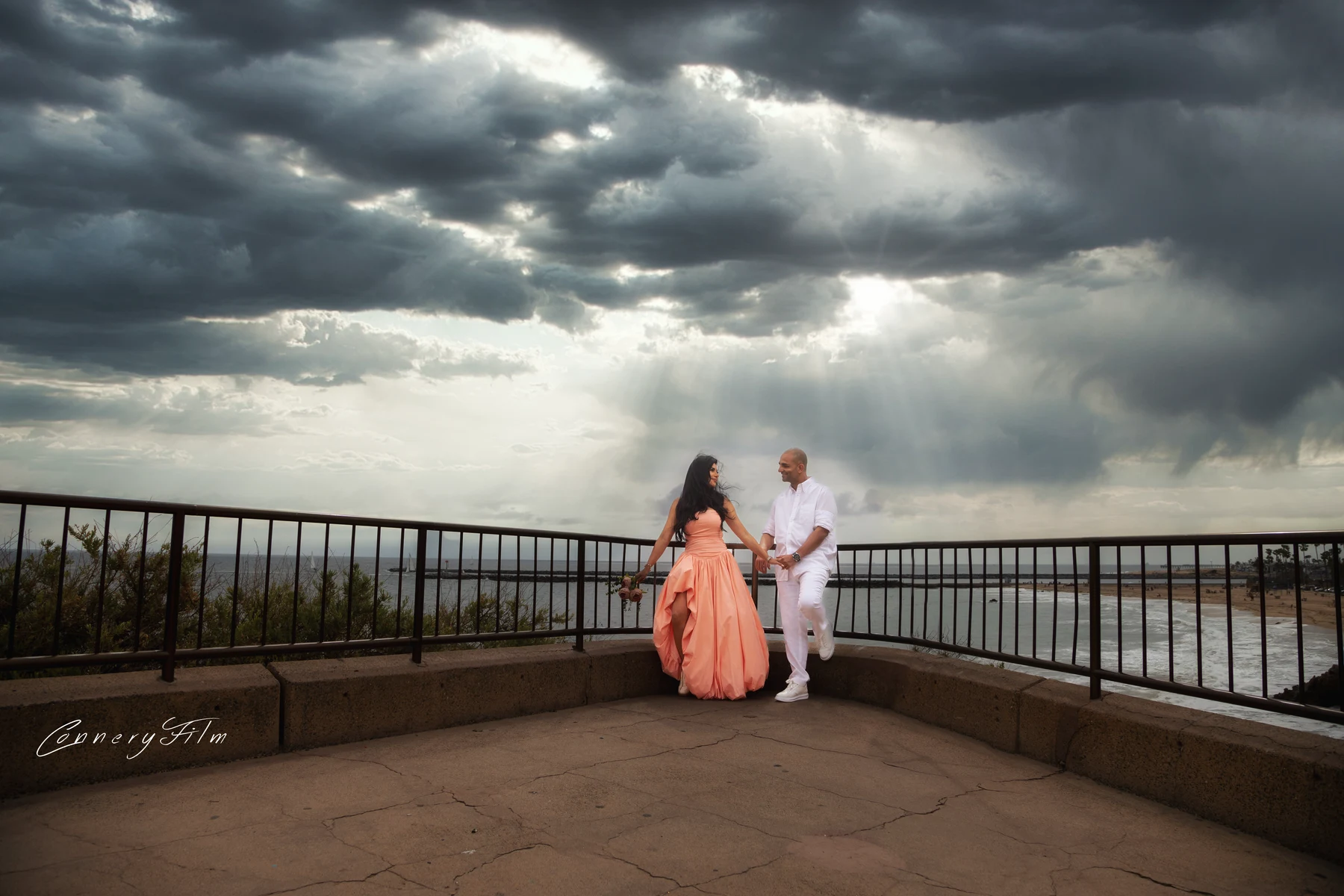
Great wedding reception photos of dancing come from three things, in this order: a dance floor that fills up fast, light that I control instead of the DJ's color wash, and a photographer who is physically inside the crowd rather than standing at the edge with a long lens. Get those three right and your Los Angeles dance floor photos will look like the best night of your life. Miss one and you get a gallery full of blurry purple silhouettes and the back of your uncle's head.
I've photographed receptions for 17 years, from 80-guest rooftop parties in the Arts District to 400-guest Persian and Armenian weddings in Glendale ballrooms where the dance floor doesn't empty until 1 AM. The couples who end up with incredible dancing photos almost never got lucky. They made a handful of planning decisions months earlier. Here are the seven that matter most.
1. Open the dance floor right after dinner, not at 9:45
I'll be blunt: the single biggest killer of good dancing photos is a timeline that pushes open dancing too late. When dinner ends at 8:15 and the floor doesn't open until 9:30 because toasts, cake and a slideshow were stacked in between, the energy drops. Grandparents leave. Kids fall asleep on chairs. By the time the music starts, half the room is checking rideshare apps.
What I tell couples at consultations: go straight from your first dance into an open floor, ideally with a high-energy song the whole family knows. Do toasts during the salad course and cut the cake later, as a break between dance sets. The first 20-30 minutes after the floor opens are when I get 60-70% of my strongest dancing frames. Everyone is fresh, dressed up, makeup still perfect, and nobody has spilled anything yet.
This also matters for your budget. Most of my couples book 8 hours, and I've written about how long photographers usually stay into an LA reception. If open dancing starts at 9:45 and coverage ends at 10:30, you are paying for 45 minutes of the best part of the night. Start it at 8:30 and you get two full hours.
2. Talk to your DJ about the lighting before you talk to me
Most photographers won't say this, but uplighting and DJ effects can wreck dancing photos more than any camera setting. Saturated red, magenta and deep blue LEDs turn skin into something out of a horror film, and they are nearly impossible to fully correct in editing because there's no real color information left in the faces.
Here's what actually works:
- Warm white or amber uplighting on the walls. It flatters skin and photographs beautifully.
- A dimmable house light level around 30-40% over the dance floor, not full blackout. Total darkness forces every photographer into harsh flash-only frames.
- Moving heads and lasers for accents only, aimed above head height. Colored beams in the background look fantastic; colored light on faces does not.
- Haze or fog, used lightly. A little haze makes my backlight glow. A lot of it turns every frame milky grey.
In venues like the Millwick in the Arts District or a Hollywood Hills estate, there is often very little house light at all after sunset, so this conversation matters even more. I covered the technical side in my exact settings for low-light indoor receptions, but the short version is this: the best light for dancing is light your DJ and I agree on in advance.
3. Your photographer has to be on the floor, not next to it
The difference between a forgettable dancing photo and a framed one is usually about six feet. From the edge of the dance floor, with a 70-200mm lens, everything looks flat and distant. From inside the circle, with a 24mm or 35mm lens about three feet from your face, the photo feels like being there.
When I'm shooting the dance floor, I'm in the middle of it. I'll step into the hora circle, crouch under arms during a conga line, and shoot upward from knee height when the bride gets lifted in a chair. Guests stop noticing the camera after about ten minutes, which is exactly when the real expressions start.
My usual dance floor kit is two bodies, one with a 24mm and one with a 35mm or 50mm, so I never miss a moment swapping lenses. I explained why in why I carry two cameras at every wedding. No zooms on the dance floor. A wide prime forces me to get close, and close is the whole point.
4. Off-camera flash is what makes the photos pop
Here's the technique behind most dancing photos you've saved on Pinterest. I put one or two small flashes on light stands in the corners of the dance floor, usually at about 7-8 feet high and angled back toward the crowd. Then I keep a third flash on my camera, bounced or very low power.
What that does:
- The corner flashes become a backlight, so you get a rim of light on hair, a glow through the veil, and sparkle on every sequin dress.
- Haze, confetti and sparkler smoke light up behind you instead of disappearing into black.
- The on-camera flash fills faces just enough to freeze motion without looking like a paparazzi shot.
- Combined with a slightly slower shutter, around 1/30 to 1/60 of a second, I can get the "dragged shutter" look: sharp faces with streaks of the room's colored lights behind them. That's the photo that captures what the music felt like.
Honestly, I think a photographer who only shoots dancing with natural light in a dark ballroom is choosing a style that doesn't fit the room. Ask candidates to show you a full reception gallery, not just their three favorite dance frames. If every picture is grainy and orange, that's their real dance floor work.
5. Plan three or four "moments" and let the rest happen
Dancing photos aren't only about random fun. Some of the most loved frames in any gallery are planned moments that unfold naturally once they start. A few I recommend:
- A parents' or grandparents' dance one song in. Grandma in the middle of the floor with every cousin cheering is a photo families frame for decades.
- A cultural dance. The hora, the Armenian shourj par, Persian dancing with the handkerchiefs, a Mexican vibora de la mar, a Filipino money dance. These are high energy and full of faces, which is exactly what I want.
- A surprise song or choreographed bit from the wedding party. I just need to know when it's coming so I'm in position. I wrote about what makes these land in why wedding dance videos go viral.
- A "last dance" with everyone circled around you before coverage ends. Ask the DJ to call it, and to make the floor circle the two of you. It's a natural ending for the gallery.
Send your planner or DJ's run-of-show to your photographer a week out. Ten seconds of warning that the money dance starts after the third song means I'm standing in the right spot with the right lens instead of getting a plate of dessert.
6. Small choices that change your dancing photos a lot
These come up at almost every consultation I do:
- Keep the dance floor central. A floor tucked into a corner behind the bar means half the guests can't see it and won't join in. A floor in the middle of the tables, with guests all around, fills instantly.
- Clear the edge of the floor. Cake tables, photo booths and gift tables right beside the floor block my angles and catch elbows.
- Change shoes if you want to, but tell me. A bride in sneakers having the time of her life looks great. A bride limping in heels looks like she's in pain.
- Bustle your dress properly. Have your maid of honor practice it before the wedding. A dragging train ends up stepped on and the photos show you constantly adjusting it.
- Sparklers, confetti and cold sparks look amazing on camera, but check your venue's fire rules first. Many LA venues, especially in Malibu, Topanga and other brush-fire areas, ban real sparklers. Cold-spark machines are a good alternative and usually rent for $300-$700 for a pair.
7. Hire photo and video as one team
The dance floor is where separate photo and video vendors collide most. Two different teams, two lighting plans, and constantly stepping into each other's frames. The videographer's bright LED panel washes out my flash. My flash pops show up in their footage. By the end of the night, someone has the better position and someone's work suffers.
That's a big reason I built ConneryFilm as a Los Angeles wedding photography and cinematic videography studio under one roof. My photo and film shooters plan the dance floor light together, take opposite sides of the floor, and know each other's moves. You get photos and a film that look like the same night, because they were made by one team. Our Photography & Cinematography package starts at $3,500, photography alone starts at $1,599, and cinematography alone starts at $1,799.
What I'd do if it were my wedding
If I were planning my own Los Angeles reception with great dancing photos as the goal, I'd do exactly this: first dance straight into an open floor by 8:30, warm amber uplighting, no colored light on faces, a central dance floor, a cultural or family dance scheduled for the first set, and at least two hours of photo coverage after the floor opens. Then I'd let the photographer disappear into the crowd and stop worrying about it. The best dance floor pictures always come from couples who stopped thinking about the camera.
Dancing photo questions couples ask me
How long should my photographer stay for dancing?
At least 60-90 minutes after open dancing starts. The strongest frames come in the first 30 minutes, but the best candid moments, like grandparents dancing or the late-night crew, often happen in the second hour.
Will flash ruin the mood on the dance floor?
No. Off-camera flash fires for a fraction of a second, and guests stop noticing it within minutes. Without it, dark receptions produce blurry, grainy, heavily colored photos that can't be fixed in editing.
Can I get good dancing photos at an outdoor reception?
Yes, if you plan the light. Once the sun sets in LA, an outdoor floor goes completely dark fast. Bistro lights, market lights or a few warm uplights on nearby trees give me something to work with, and I'll add flash on stands.
Should I ask guests to put their phones away while dancing?
I'd suggest it gently. An unplugged ceremony matters most, but a quick DJ announcement before the first set ("phones down, hands up") gets you far more photos of actual faces instead of raised screens.
How many dancing photos will I get?
For an 8-hour wedding with two hours of open dancing, expect around 100-200 edited dance floor images in the final gallery, depending on how full the floor is and how many planned moments you include.
If you want dancing photos that feel like your reception actually sounded, I'd love to hear about your venue, your music and the people who will be first on the floor. Call or text 818.749.7039, or see our weddings and packages at ConneryFilm.com, and let's plan a dance floor your family will still talk about.
Meet the Author: Connery Davoodian Hello, I'm Connery Davoodian, the visionary behind ConneryFilm, and I'm thrilled to share insights from my 17-year journey through the world of wedding photography and videography. My passion extends beyond simply capturing images; it's about artfully weaving your unique love story into a timeless, cinematic masterpiece. My artistic path began long before I ever picked up a camera, deeply rooted in music as a singer, songwriter, and multi-instrumentalist. This diverse background in directing, producing, and editing has cultivated a unique perspective, allowing me to approach each wedding not just as an event, but as a dynamic narrative waiting to be beautifully told. This blend of technical mastery and creative storytelling is the heartbeat of ConneryFilm, ensuring that every frame, every shot, and every film is infused with depth, emotion, and unparalleled artistic integrity. At ConneryFilm, we believe your wedding memories deserve nothing less than bespoke luxury. My philosophy centers on capturing the authentic, unscripted moments – the genuine smiles, the tender glances, the joyful laughter – that truly define your day. While we obsess over exquisite details and sophisticated aesthetics, our true joy comes from making you feel completely at ease, like a "friendor" who genuinely celebrates alongside you. This calm, organized presence allows your true personalities to shine, resulting in images and films that are as real and vibrant as your love itself. Based in the heart of Los Angeles, California, my team and I are privileged to serve couples across the globe, bringing our signature high-end wedding photography and videography to destination weddings worldwide. Through these blog posts, I aim to share invaluable insights, luxurious inspiration, and practical, fun advice to guide you through your wedding planning journey, helping you make informed decisions about preserving your most cherished moments. Thank you for trusting ConneryFilm to be a part of your extraordinary adventure. I'm excited to share my knowledge and passion with you, helping you create memories that will last forever.